
The Window for Vertical AI in Marketing Is Narrowing
Good morning,
Ninety-one percent of marketing teams now use AI in their work, according to Jasper's 2026 survey of 1,400 marketers. That number sounds like saturation. It's not. Most of that adoption is still shallow: copy generation, some creative development and prototyping. But something is shifting underneath. AI giants are pushing into enterprise workflows. Marketing-native platforms are rebuilding their stacks around automation. A new wave of vertical AI companies is trying to own what sits in between. All three are moving at once, and the question isn't whether this goes deeper, it's how fast, and how far.
Let's get into it.
Vas
THIS WEEK’S SIGNALS
AI & Marketing
Bots will outnumber humans online by 2027. Cloudflare CEO Matthew Prince projects that AI agent traffic will exceed human web traffic within a year. The math is simple: a human researching a camera might visit 5 sites. An AI agent doing the same task hits 50. Open In Chat GPT
Walmart says ChatGPT checkout converts 3x worse than its own site. Walmart tested around 200,000 products through OpenAI's Instant Checkout. The result: in-chat purchases converted at roughly one-third the rate of Walmart.com. The takeaway: AI is good at discovery, bad at closing. The transaction layer still belongs to the brand.Open In Chat GPT
AI is fueling the in-housing surge and agency execs are leaving. An Adweek report puts numbers on what everyone has felt: 32% of brands expect to handle nearly all creative internally within 12 months. Meanwhile, 54% of agency leaders say they're likely to start their own firm within two years.Open In Chat GPT
Apple made ~$900M from AI apps without building the best AI. Apple's AI app revenue hit approximately $900M not by building the most capable models, but by owning the distribution surface.Open In Chat GPT
Vertical & Enterprise
OpenAI is hiring like it's 2021 again. The company plans to grow to 8,000 employees by end-2026, with new roles in product, sales, and "technical ambassadorship" for customer integration. The target is 50% of revenue from enterprise customers, up from 40%.Open In Chat GPT
Perplexity expands into health and browsing. Perplexity Health lets Pro and Max subscribers sync wearable data, lab results, and medical records into personalized dashboards. Will it succeed where everyone else has failed in the past?Open In Chat GPT
DoorDash is selling real-world data to train AI. Through its new Tasks program, DoorDash pays Dashers to capture structured video walking footage, object-pointing, indoor retail environments to train vision and robotics models. A logistics company monetizing its workforce as a data collection network.Open In Chat GPT
BIG PICTURE

The Window for Vertical AI in Marketing Is Narrowing
At the start of 2026, the narrative around vertical AI in marketing is no longer just about opportunity, it’s about timing. Three forces are converging fast, and together they’re compressing the space where new entrants can win.
1) The AI Giants Are Moving Down the StackWhat started as a model race is becoming a workflow land grab. OpenAI, Anthropic, and Google are no longer just infrastructure providers — they're embedding themselves into enterprise operations. Hiring integration teams, building agent layers, capturing procurement budgets. The goal isn't to power how work gets done. It's to own it.
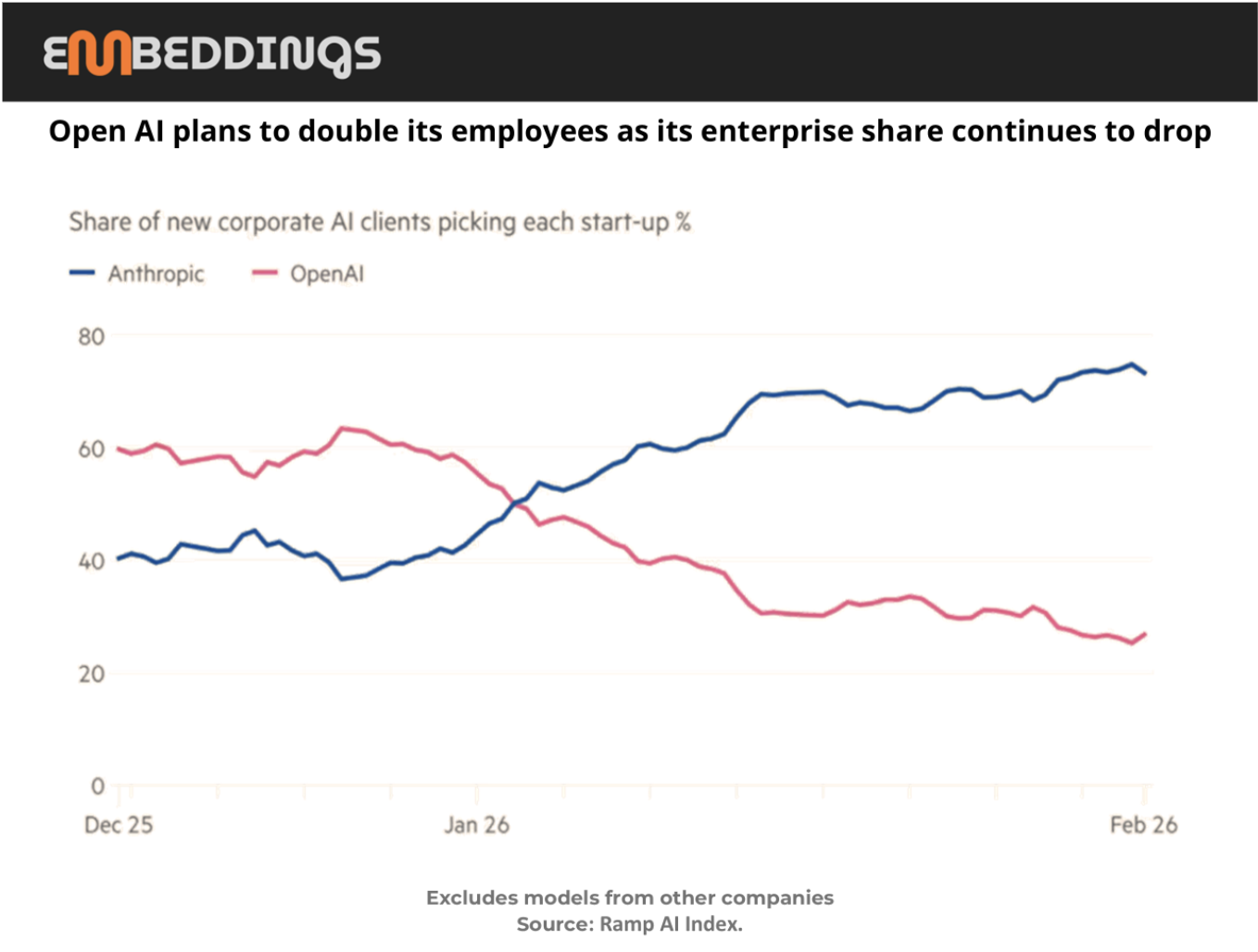
This matters because the model layer is commoditizing fast. Access is cheap, capability gaps are narrowing, and building on top of these systems has never been easier. That's exactly why the giants aren't staying there. If the foundation becomes a commodity, the value moves to whoever controls the layer above it and they're moving to claim it first.
2) Incumbents Are Absorbing AI NativelyAt the same time, the platforms that already control marketing spend ( Meta, google etc) are rapidly integrating AI into their core products. This isn't experimentation. It's consolidation. Campaign creation, targeting, optimization, creative generation: all of it moving inside platforms that already own the budget relationship.
The obvious read is that standalone tools get squeezed. That's probably true at the margins. But consolidation creates its own vulnerabilities. The same platforms asking for your data, your creative, and your strategic logic are also the ones grading their own homework. Transparency is thin. Costs are rising. And the product, for all its integration, is built for everyone, which means it's optimized for no one in particular.
The question isn't whether marketers will use these platforms. They already do. The question is how much they'll actually hand over.
3) Vertical Startups Are Racing Procurement RealityDespite strong growth, vertical AI is still fighting an uphill battle in enterprise adoption.
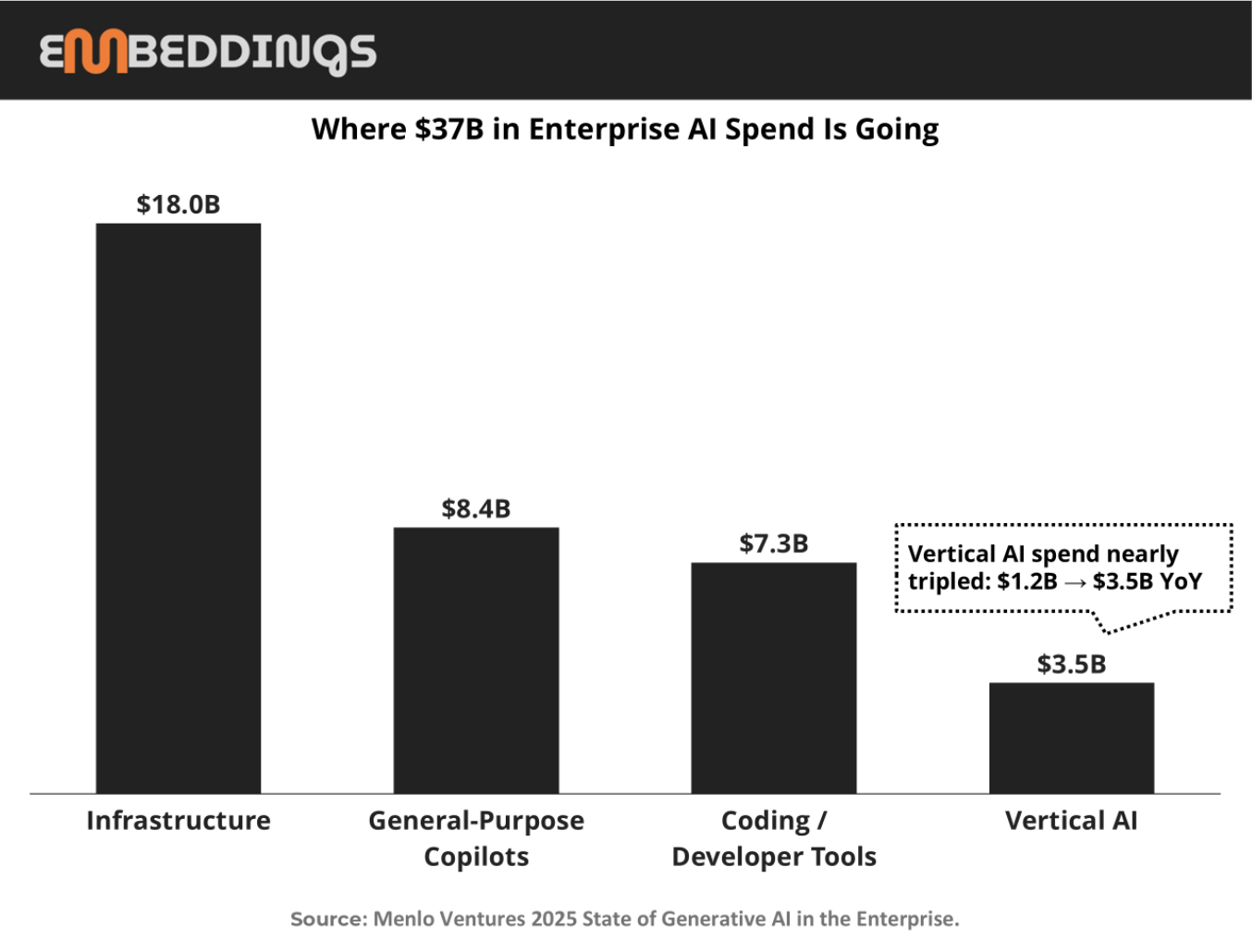
Horizontal won in 2025 for the same reasons that it wins early in a technology wave: because these tools are easier to buy, deploy, and scale across teams. One vendor, one contract, immediate ROI. But that advantage doesn’t last forever.
As expectations shift from “time saved” to “revenue generated,” generic copilots start to hit their limits. They can assist, but they can’t fully execute within the complexity of real marketing workflows, attribution, approvals, platform integrations.
That’s where vertical AI wins, but only if it goes deep enough.
The Real Battleground: Owning the Workflow
If you're a vertical AI company building in marketing right now, the window is real but it's narrowing. From above, the AI giants are making it easier to build but also easier for incumbents to absorb your features. From the side, Disney, Meta, google and the other platforms are rebuilding their stacks with native AI. From below, consumers are changing behavior fast enough to create demand, but not fast enough to abandon established channels.
The companies that will own this category are the ones that solve a full job and get client traction, not a prompt wrapper, not a feature, but a workflow that a platform can't replicate in a quarter. AI-search visibility. End-to-end campaign operations. Agent-led media execution. Creative production systems with compliance built in.
Everyone else is building a feature that will get acquired or absorbed. The clock is running.
Sources:MENLO: 2025: The State of Generative AI in the Enterprise | OpenAI to double workforce as business push intensifies
COMPANY FEATURES
Gradial, The Operations Layer Between Brief and Live
Marketing teams typically spend 80% of time on manual, repetitive tasks: A campaign brief gets written. Then it sits in a queue. A designer touches it. A copywriter touches it. Compliance reviews it. Someone checks brand guidelines. Someone uploads it to the CMS. The work between "idea" and "live" takes days or weeks, involves a dozen handoffs, and none of it is the creative part.
Gradial (founded 2023, $55M raised, 30x YoY revenue growth in 2024) builds AI agents that automate that execution layer. Content authoring, brand compliance, QA, accessibility checks, campaign orchestration, all running across the systems teams already use: CMS platforms, Jira, Workfront, Figma.
Why this is valuable in practice:
Full workflow, not a feature. A copilot can write a headline. Gradial's agents take a brief, generate the content, check it against brand guidelines, validate accessibility, push it into the CMS, and deploy it. Across thousands of pages.
Enterprise-scale deployment: T-Mobile reported an 80% reduction in time-to-market and 10x more volume. Other named customers include Microsoft, AWS, Prudential, Adobe, and Dentsu/Merkle.
Fast capital trajectory: $13M Series A in March 2025 led by Madrona. $35M Series B nine months later led by VMG Partners. Madrona's investment memo called it one of "the only agentic startups deployed at scale in the Fortune 1000."
The underlying trend is real: 32% of brands expect to handle nearly all creative internally within 12 months. Those brands need operational infrastructure to execute at scale without the agency headcount.
The question is whether Gradial can embed deeply enough that switching costs stick before someone bigger builds or buys its way in.
ONE THING TO DO THIS WEEK
Map the handoffs in your last campaign –from brief to live. Count the people, the tools, the approval steps, the days. Then ask: which of these steps is a human making a judgment call, and which is a human doing a repetitive task that an agent could handle? That ratio tells you how exposed your team is to the shift happening right now.
*Marketing Embeddings is read by 20,000+ CMOs, CTOs, and media leaders navigating AI's impact on marketing. Forward this to someone who needs to see it.*
