
Welcome back, Embedders. he same three arguments keep running about AI, in different rooms.
Room one is control. Last week's headlines were not product news, they were power news: Apple suing OpenAI over stolen hardware secrets, Anthropic settling with authors for $1.5 billion, and Washington weighing a ban on Chinese open models after Moonshot's Kimi K3 landed near the frontier.
Room two is ROI. Chamath Palihapitiya, an All-In host who now runs the enterprise AI firm 8090, says his token costs are doubling every 45 days while the productivity they buy is up about 5 percent. The math is starting to bite, and the cheapest way out keeps pointing at open models, several of them Chinese. That is the knot last week tightened: the cost formula is bending toward open weights just as the US moves to wall the best open weights off.
Room three is the work. Shoppers are turning on AI-made ads, Google is now labeling which ads AI made, and Omnicom is rebuilding what an agency even sells. Use the same tools built on the same models and the work starts to look the same, so the tool stopped being the constraint.
None of these arguments is about which model is smartest. They are about whether all that spending ever turns into profit, whether your work still stands out once everyone has the same tools, and who gets to make the rules. Everything else is just tokens.
- Vas
Big Picture (the power turn)
Washington weighs banning Chinese open models
After Moonshot's Kimi K3 shipped near-frontier performance as a free open-weight model, the Trump administration is reportedly weighing ways to restrict Chinese AI models in the US, from Entity List designations to procurement limits. The bind: open weights are downloadable, so an outright ban is close to unenforceable, and the cheapest capable models on the market are the ones being targeted. (Axios)
Apple sues OpenAI over stolen hardware secrets
Apple filed a trade-secret suit accusing OpenAI of using current and former staff to lift hardware designs for a rival device, naming OpenAI hardware chief Tang Tan (ex-Apple) and a former Apple engineer. More than 400 ex-Apple employees now work at OpenAI, and Apple's filing escalates a commercial spat into a criminal allegation. (TNW)
Anthropic's $1.5 billion book-piracy settlement is approved
A judge approved Anthropic's settlement with authors, about $3,000 per work across an estimated 500,000 works, the largest payout in US copyright history. The court held that training on text is fair use, but that Anthropic broke the law by sourcing the books from pirate sites. (TechCrunch)
AI and Marketing
Shoppers are turning on AI-made ads
Consumer distrust of AI-generated ads is now one of the season's defining marketing trends, with a wide gap between how well marketers assume the ads land and how audiences actually react. TikTok is moving to ban AI voices in shopping livestreams, and undisclosed synthetic content tends to backfire harder than content flagged upfront. (The Independent)
Google adds "How this ad was made" AI labels
Google is rolling out a panel across Search, YouTube, and Discover that flags whether an ad was created or edited with AI. Ads built with Google's own tools get labeled automatically, while advertisers using outside tools must now disclose it themselves. (Google)
Omnicom says it is a "capability company," not a holding company
As AI automates media execution, optimization, and data work, Omnicom Media's North America CEO says the old holding-company model is fading and agencies must sell strategy, not scale. The tell for marketers: when AI lowers the barrier to entry, competition rises and agency fees stop tracking headcount. (Digiday)
How Much, Not How Smart
The binding constraint on enterprise AI has moved from capability to cost. Palihapitiya put a number on it last week: token costs doubling every 45 days against about 5 percent more productivity (All-In). Once spend outruns the return like that, CFOs stop treating AI as a black box and start asking where it lands on the income statement. If your AI bill doubles, it has to show up in lower cost or higher revenue, and right now, for most, it shows up in neither. Palihapitiya says he cut his own token bill 95 percent by routing queries to an open-weight model, which tells you where he thinks this goes.
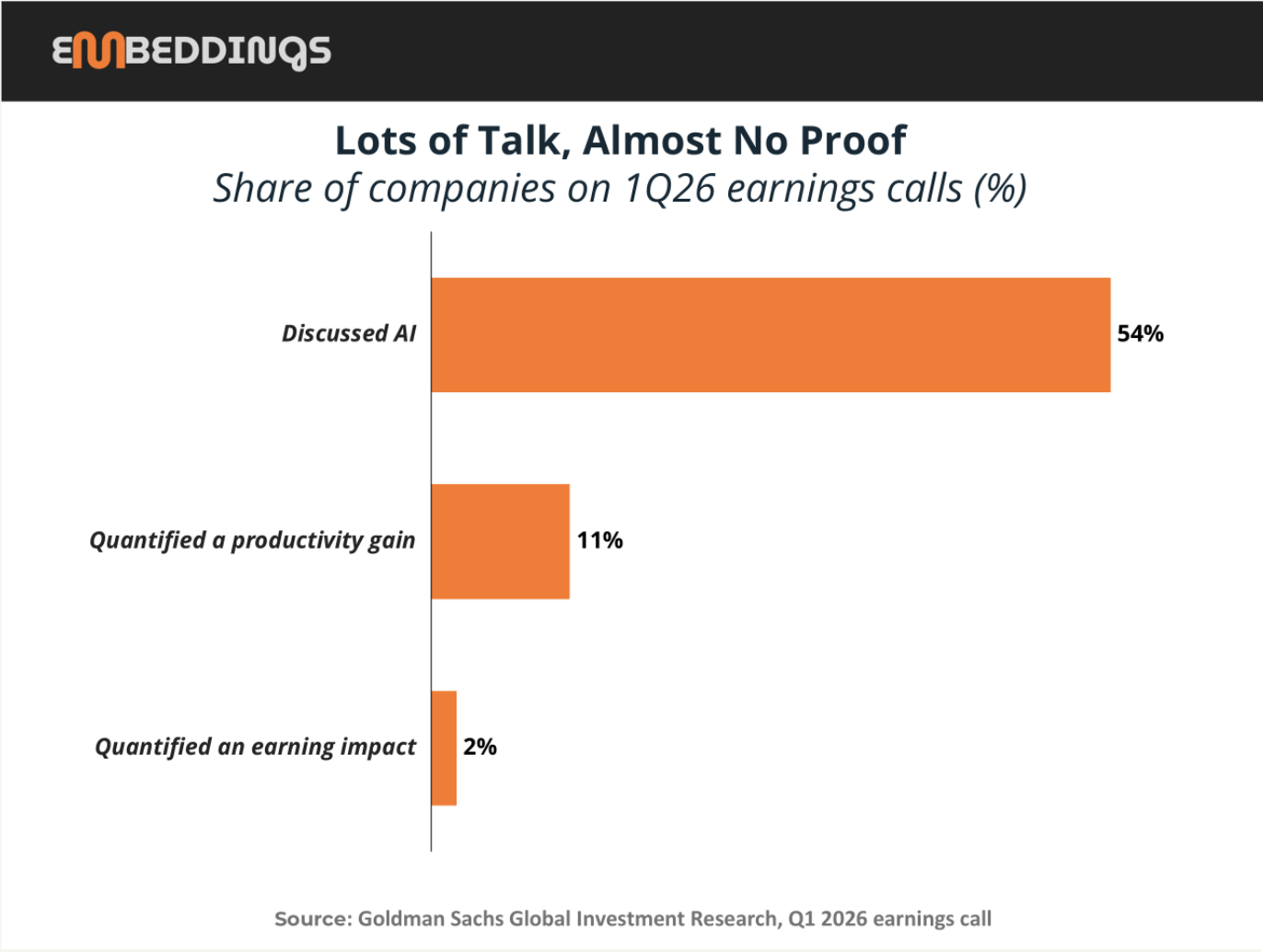
The data backs the setup. Ramp, tracking 70,000 companies, clocked business AI spend up 497 percent from January 2025 to April 2026, with token usage up 1,001 percent as prices fell (Ramp AI Index). Goldman Sachs combed through first-quarter earnings calls and found 54 percent of companies discussed AI, only 11 percent could quantify a productivity benefit, and just 2 percent an impact on earnings (Goldman Sachs Global Investment Research). MIT's 2025 GenAI Divide study of 300 deployments found 95 percent of custom enterprise pilots showed no measurable profit-and-loss impact, a figure others have since contested (MIT NANDA). The spend is real. The line on the income statement is not.
Last week OpenAI shipped the GPT-5.6 family and led not with raw intelligence but with performance per dollar, pricing its models at roughly half of Claude Fable 5 (OpenAI). The scoreboard is mixed, and worth stating straight: Fable 5 still leads on real-world coding, 80 percent to 64.6 percent on SWE-Bench Pro, though independent evaluators have questioned that Fable score, while GPT-5.6 leads on agentic and terminal benchmarks. When you can no longer claim the single smartest model, you compete on the cheapest useful one. Follow the tokens.
Sources
All-In podcast, Chamath on 8090 token costs: share.snipd.com/episode/12405c01
OpenAI, GPT-5.6 launch: openai.com/index/gpt-5-6
Ramp AI Index (spend +497%, usage +1,001%): ramp.com/data/ai-index
Goldman Sachs Global Investment Research, AI and S&P 500 earnings (June 12, 2026)
MIT NANDA, "The GenAI Divide" / State of AI in Business 2025 (95% of pilots, contested)
Apple v OpenAI: thenextweb.com/news/apple-sues-openai-trade-secrets-theft-hardware
Anthropic $1.5B copyright settlement (TechCrunch): techcrunch.com/2026/07/20/anthropics-landmark-1-5b-copyright-settlement-is-approved
US weighs banning Chinese open models / Kimi K3 (Axios): axios.com/2026/07/20/ai-us-china-open-source-kimi
Shoppers turning on AI ads / TikTok (The Independent): independent.co.uk/us/money/tiktok-brands-ai-ads-b3015535
Google Ads AI transparency labels: blog.google/products/ads-commerce/google-ads-ai-transparency-labels
Omnicom rethinks the agency model (Digiday): digiday.com/podcasts/as-ai-automates-media-work-omnicom-media-is-rethinking-the-agency-business-model
