
AI Visibility Now Moves Like Weather
Welcome back, Embedders.
One ChatGPT update this week halved some brands' presence in AI answers, overnight and without warning. AI visibility can move that fast now, and you rarely see it coming or control it.
This week's embedding: brand visibility is a coordinate in a model we don't control, and it moves when the model does.
- Vas
AI and Marketing
Machines are the majority of your traffic
Automated requests now make up 58 percent of web traffic, with agent activity up roughly 8,000 percent in a year (Cloudflare), and the systems built to tell bot from human miss 7 to 15 percent of the time. Cloudflare's September deadline forces AI crawlers to pay publishers or lose access, an early attempt to price a reader that never sees an ad. For marketers the implication is plain: the page has to satisfy the parser as much as the buyer, because more often the parser goes first. (Cloudflare, via TNW)
In ChatGPT, most categories have no clear leader
Semrush mapped 1,094 US categories in ChatGPT and found a clear leading brand in 15 percent of them and none at all in 54 percent, with 98 percent of buyer volume landing in categories nobody owns. The signals that used to earn the spot barely apply: organic traffic and authority scores track weakly to whether a model names you, and only 21 percent of the most-cited domains are also the most-mentioned brands. The one steadying force is incumbency, since an established leader holds the top spot in more than 90 percent of month-to-month checks. So the instability cuts hardest for the 85 percent still contesting a category; the few who own theirs get something closer to a fixed position. (Semrush, via MarTech)
The open-weights letter names its holdouts
Twenty-five companies signed a July 24 letter arguing that an open-weight ecosystem, not a single frontier model, is how the US keeps its AI lead, and that closed models are "not inherently safe" because outsiders cannot inspect them. The signatures carry the argument: Nvidia, Meta, Mistral, a16z, and Hugging Face are in; OpenAI, Anthropic, and Google, the three with the most to lose from opening up, are not. It is the same control fight over Chinese open models we tracked last week, now with the US labs' positions made explicit. Who signs a rules letter tells you who the rules would protect. (TNW)
AI's cost is moving into media markups
Holding companies are offering to absorb AI infrastructure costs if a client routes 70 percent of budget through principal media, the inventory agencies buy wholesale and resell at a markup; one version drops the agency fee entirely in exchange for all of it. The cost of the models does not leave the table, it moves into a line the client cannot audit. As Robert Webster, a former WPP executive, put it, much of agencies' claimed AI investment is "manufactured to justify exactly this ... skimming money out of media." (Digiday)
One Update, Opposite Outcomes
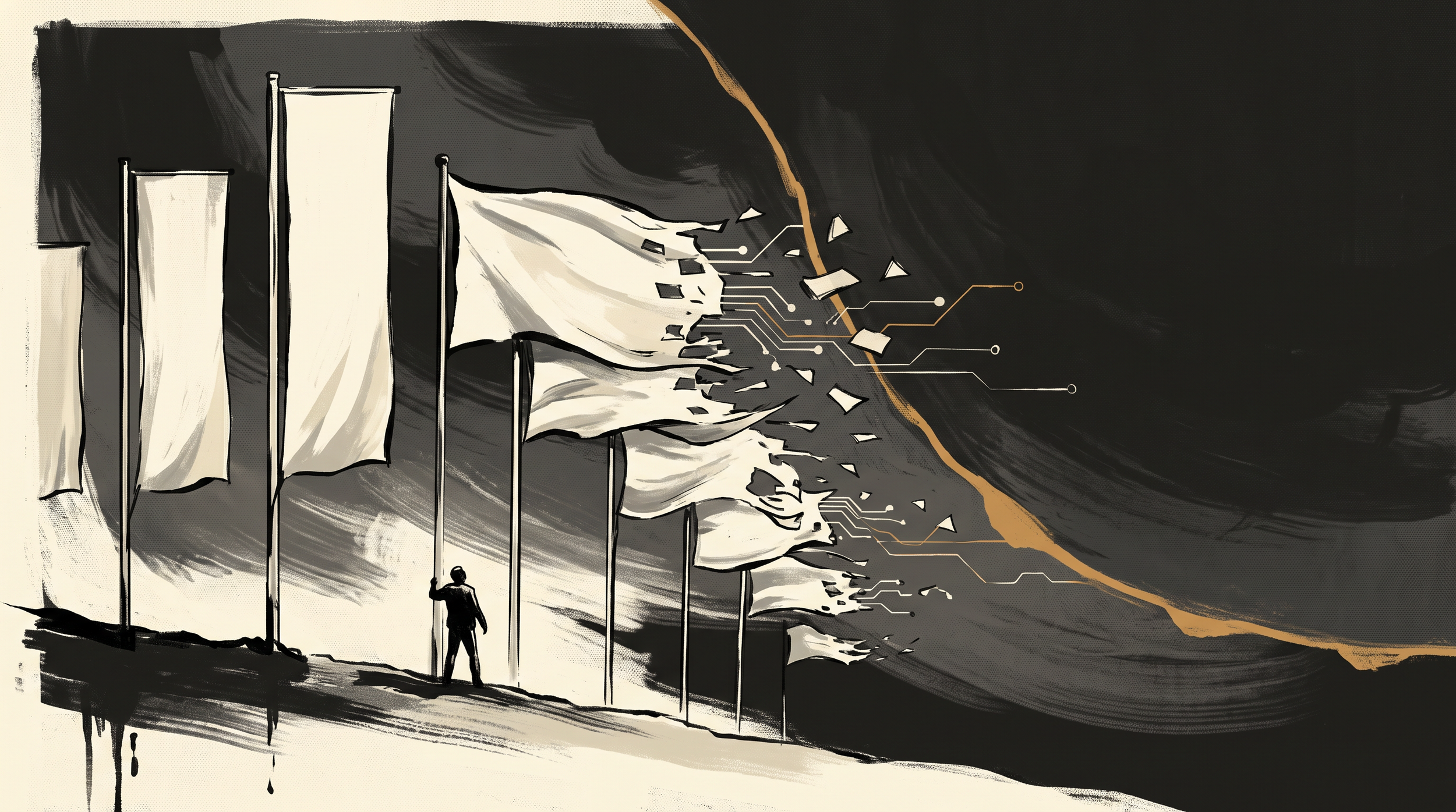
SEO taught marketers to treat visibility as a rank you climb and then hold. AI search is turning it into something closer to weather.
The clearest evidence yet comes from Profound, which on June 29 launched the Profound Index, a daily benchmark of AI visibility built on more than 1.5 billion prompts across 50-plus industries (Profound). Its first release showed how fast the ground moves. After a single ChatGPT model update, Travelocity, Orbitz, and Priceline fell 35 to 56 percent; health insurers Ambetter and Humana dropped more than 50 percent while Aetna moved the other way; and ChatGPT began recommending rival AI tools like Anthropic, Mistral, and Groq more often inside its own answers. One update, and category leaders lost half their presence in an answer box they neither own nor control. Treat the exact figures as vendor-reported and directional, but the pattern is the point.
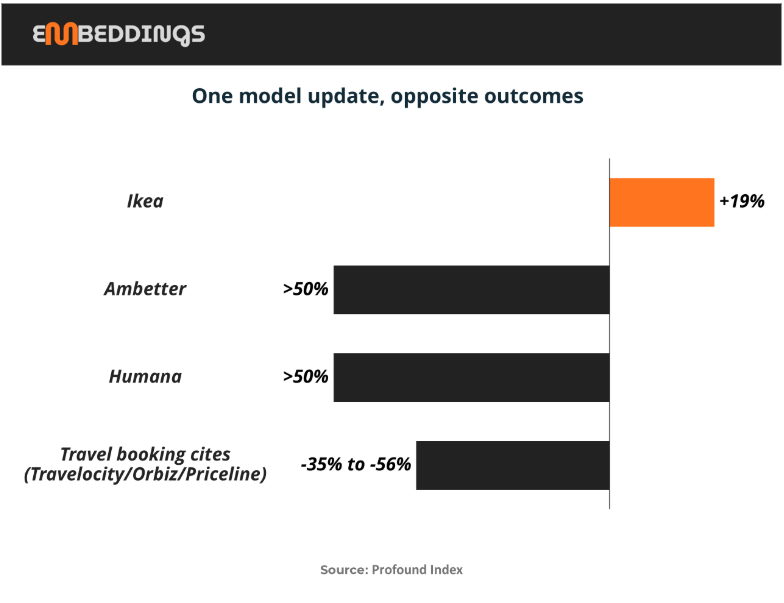
It gets harder. The same brand can move in opposite directions depending on the engine. IKEA rose 19 percent on ChatGPT while falling 11 percent across AI platforms overall (Profound). There is no single "AI visibility" to optimize for. Each engine is its own weather system, and they do not agree.
This is different in kind from the SEO era. Google's algorithm changed too, but rankings held relatively steady between updates and you optimized against a known target. In AI search, the target is a model that gets retrained and swapped out from under you, and a 50 percent swing can arrive with a version bump you had no say in and no warning about. For a CMO, that turns AI visibility from a project you finish into a position you defend, continuously.
In April we flagged the gap in the tooling: the GEO stack was mostly selling monitoring rather than the harder work of changing the answer. Insights, not action. That was tolerable when visibility drifted slowly. It is a real problem when visibility can halve overnight, because a dashboard that reports last week is no defense against a model update that lands tomorrow.
So the problem shifts from measuring AI visibility to managing its volatility, the action layer that responds when the ground moves. Profound followed its Index with Aim, an always-on agent meant to catch what changed, explain why it matters, and push a response into motion. Whether an agent can steady a metric it does not control is unproven, and handing your visibility playbook to the platform selling the fix carries its own cost. But the direction is right. In a channel this unstable, the tools that win will be the ones that help you respond, not just watch.
Sources
Profound Index launch (1.5B prompts, 50+ industries, ChatGPT 5.5 movements): tryprofound.com/blog/introducing-the-profound-index
Profound Aim launch (July 2): globenewswire.com/news-release/2026/07/02 (Profound Aim)
Semrush, no clear brand leader in most ChatGPT categories (via MarTech): martech.org/chatgpt-has-no-clear-brand-leader-in-most-categories
Bots outnumber humans / 58% automated traffic (Cloudflare, via TNW): thenextweb.com/news/bots-outnumber-humans-internet-ai-agents-traffic
AI costs and principal media (Digiday): digiday.com/marketing/how-ai-costs-are-quietly-reshaping-principal-media-deals
Open-weights American AI leadership letter (July 24, via TNW): thenextweb.com/news/open-weights-american-ai-leadership-letter-huang-nvidia-openai-absent
