
Open Source, Measured Three Ways
Welcome back, embedders. This week we look at where open source stands, measured three ways: who pays for it, who uses it, and who wants to regulate it. As models get cheaper, the question underneath is who controls the price, and it is not settled. We start with the part that shows up on your invoice, then cover the week's other signals across AI, regulation, and marketing.
- Vas
Big Picture
The token bill is now a C-suite problem
EY built an internal "AI router" that sends each task to the cheapest model that can handle it, reserving the expensive ones for the hard problems. The firm spends over $1 billion a year on AI and runs about 1,000 agents, and its own survey found 82 percent of leaders worried about token costs while only 64 percent actively meter them. As Dan Diasio, EY's global AI consulting leader, put it: "'AI saves time' is no longer a sufficient business case when the costs are mounting and difficult to ascertain over the long run." The first phase of the boom asked whether the tool worked. This one asks what it costs. (TNW)
The EU's synthetic-content rules went live
From August 2, providers must embed machine-readable markings in AI output and deployers must disclose deepfakes and machine-written text, with chatbots required to identify themselves at first contact. Fines run to €15 million or 3 percent of global turnover. There are carve-outs for clearly fantastical work and for text a human has meaningfully reviewed and taken responsibility for, and advertisers lobbied to exempt AI-generated ads. The catch is enforcement: watermarks strip and machine text is hard to detect, so the rule is only as strong as the tools that check it. (TNW)
A German court found an AI music maker broke copyright
The Munich Regional Court ruled that Suno trained on GEMA-represented songs without permission and reproduced them, memorizing six recognizable hits, in one of Europe's first binding decisions on AI-generated music. Suno, valued around $5.4 billion, must now disclose the revenue it earned so damages can be set, and the ruling is enforceable while it appeals. The training-data reckoning that hit text is reaching sound, and the same court already found ChatGPT infringed song lyrics last year. (TNW)
AI and Marketing
A publisher started selling ads to AI agents
Time is serving "agent ads," brand FAQs embedded in stripped-down markdown versions of its pages, with Ally Bank and the Project Management Institute among the first buyers. The logic is blunt: influence the model that answers, not the human who reads. Jonah Goodhart, CEO of ad-tech partner Mobian, argues that swaying what ChatGPT says about a brand moves more than any single campaign could. Time now sees more bot traffic than human traffic most days, so it is trying to monetize the crawlers, though whether LLMs treat these as ads or as cloaking to be penalized is still unknown. (Digiday)
Advertisers are funding the AI slop they are trying to avoid
A report from TAG, the ANA, and data partner Fiducia found that cheap, mass-produced AI pages built to harvest ad dollars are passing the quality checks advertisers use to screen out junk, and in some cases brands pay more to sit next to slop than beside legitimate publishers. Social is the fastest-growing home for it. The verification tools meant to keep budgets clean are being fooled by the very content those budgets are accidentally paying for. (Adweek)
LinkedIn added a "Seems like AI slop" button
Taps will train classifiers to spot low-quality content, and the platform is retiring its "Enhance your post" rewrite tool for a proofreader meant to keep the writer's voice. Detection firm Pangram estimates about 41 percent of long-form LinkedIn posts are now fully AI-generated. The tells are familiar, throat-clearing intros and the "it's not x, it's y" construction, but as models improve it turns into whac-a-mole, and once you cannot tell the difference, there is no difference. (Shelly Palmer)
How Much, Not How Smart

Washington is weighing whether to restrict it, Treasury is threatening sanctions over IP theft after saying it found watermarks of US models inside Chinese ones, and an industry letter that opened with about 25 signatories and passed 200 within a week is urging Washington not to overreach. Before taking a side, it helps to see where things actually stand, because the answer changes with what you measure.
Money is the cleanest signal, and it points hard at the closed labs. Anthropic's run-rate revenue crossed $47 billion in May, putting it ahead of OpenAI by most estimates, with analysts projecting $80 to $100 billion by year end. If dollars were the only meter, the closed labs would look untouchable.
But dollars are a thin read on activity. A Linux Foundation working paper by Frank Nagle and Daniel Yue found closed models hold about 80 percent of usage and 96 percent of revenue while costing roughly six times more per call. Yet by raw token volume, the work actually being done, open-weight models have crossed into the majority on OpenRouter, up from about a third in late 2025.
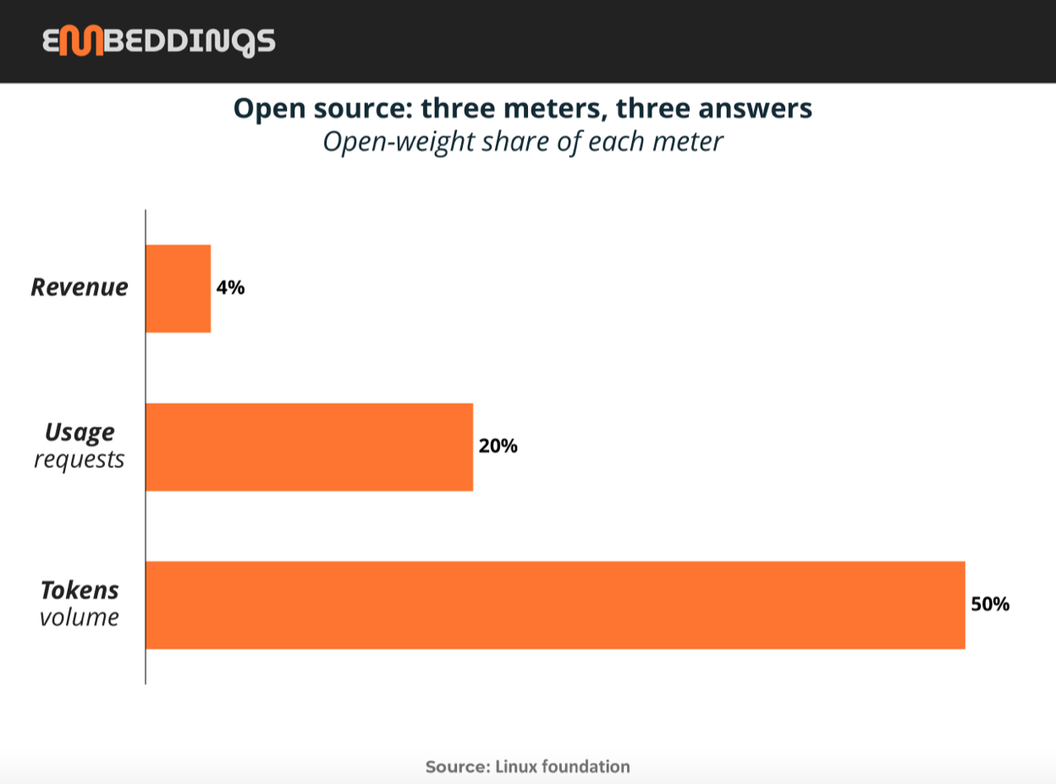
None of this is settled. Open is taking the cheap, high-volume tier, coding and agents; closed is holding the scarce, high-value calls that pay. Washington's fight is over which one keeps growing.
This is more than a trade dispute. The binding constraint on enterprise AI has moved from capability to cost, and that turns open source into the buyer's lever: the main force keeping the closed labs honest on price, and the only clean exit when the meter runs too hot. Regulate it away and you do more than pick a geopolitical side; you take the cost engineer's best tool and hand pricing power back to the labs whose revenue is already racing toward $100 billion. Keeping open source alive keeps a lever in the buyer's hand.
Sources
Open Weights and American AI Leadership letter (TechCrunch, July 24): techcrunch.com/2026/07/24/as-us-weighs-response-to-chinese-ai
Bessent / Treasury sanctions threat over IP theft (CNBC, July 21): cnbc.com/2026/07/21/bessent-china-ai-sanctions
Anthropic ~$47B run-rate, ahead of OpenAI (Epoch AI): epoch.ai/data-insights/anthropic-openai-revenue
Open models economics, 80% usage / 96% revenue / ~6x cost (Linux Foundation; Nagle & Yue, SSRN 2025): linuxfoundation.org/blog/revealing-the-hidden-economics-of-open-models
Open-weight token majority on OpenRouter, up from ~1/3 late 2025: stateofopensource.ai
EY AI router, $1B/yr, ~1,000 agents, 82%/64%, Diasio quote (TNW; EY US AI Pulse): thenextweb.com/news/ey-ai-router-token-costs
EU AI Act transparency obligations live Aug 2 (TNW; AI Act Art. 50): thenextweb.com/news/eu-ai-act-labels-compulsory-synthetic-content
Munich court v Suno / GEMA (TNW): thenextweb.com/news/german-court-suno-ai-music-copyright-gema
Time serving agent ads (Digiday): digiday.com/media/time-has-started-serving-ads-to-ai-agents
AI slop in the ad supply chain, TAG / ANA / Fiducia (Adweek): adweek.com/media/ai-slop-is-fooling-advertisers-verification-tools
LinkedIn "Seems like AI slop" button, Pangram 41% (Shelly Palmer; also TechCrunch): shellypalmer.com/2026/07/linkedin-is-adding-a-seems-like-ai-slop-button
