
The 81-Point Gap in Marketing’s AI Adoption
Good morning
87% of marketing teams use AI. 6% have fully embedded it. That 81-point gap is the most honest number in marketing right now, because it measures the distance between what we told the board and what's actually running. This issue is about that gap: why it's widening, who's closing it, and what the new tooling layer looks like.
Vas
Marketing x AI
Open AI is working to bring conversational, interactive ad units to ChatGPT.(Read more)
Marketers adopt “no AI” disclaimers to stand out to amid consumer AI skepticism. (Read more)
Why a “human touch” still matters in AI-written emails. (Read more)
AI at large
AI-powered “vibe coding” tools have driven an 84% jump in new app submissions to Apple’s App Store in a single quarter. (Read more)
How A.I. Helped One Man (and His Brother) Build a $1.8 Billion Company. (Read more)
FROM THE DESK
Last week we asked the question: what is AI doing to your own thinking? I built The Pulse, a 45-second weekly check-in that tracks how AI shapes your cognition, curiosity, and sense of meaning at work. Seven questions, research-backed. Take it this week and I'll report the first aggregate findings when we have large sample.
BIG PICTURE

The 81-Point Gap
Marketing Embeddings
Every function is adopting AI. Almost no function has figured out what to do with it. That's the headline from first quarterly State of AI report, by AIDB (by the creators of the AI Daily Brief), and the data is uncomfortably specific.
Across seven enterprise functions, adoption rates range from 52% to 90%. Value realization ranges from 6% to 25%. The gap between "we're using it" and "it's working" averages 60+ points. Software dev: 90% adoption, 7% always use. Contact centers: 88% deployed, 25% operationalized. Agentic AI broadly: 79% adopted, roughly half stuck at pilot.
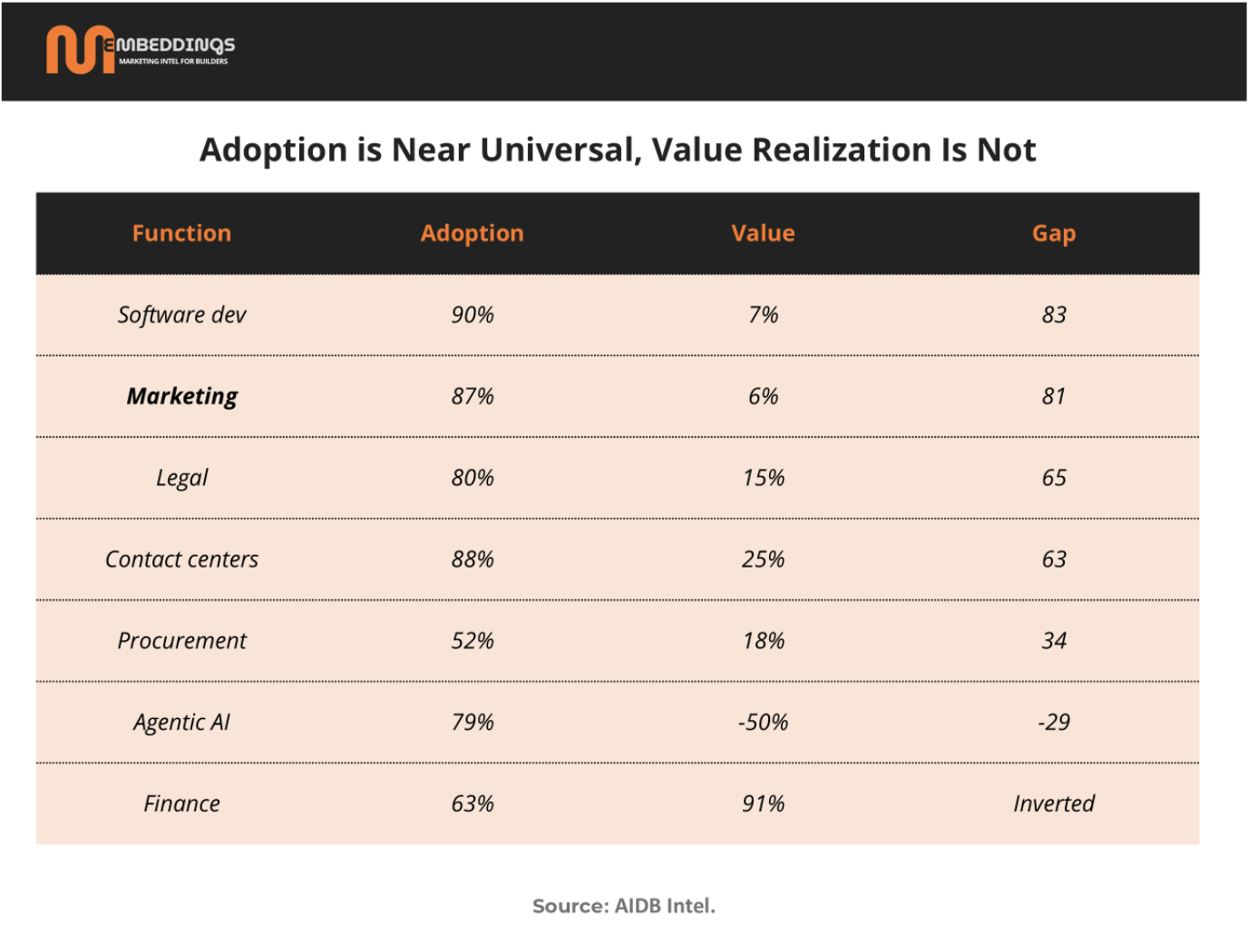
But marketing owns the most revealing line in the table. 87% of marketers use AI for content. 6% are fully embedded. That's an 81-point gap — the second widest of any function measured.
Now look at what's forming on the other side of that gap.
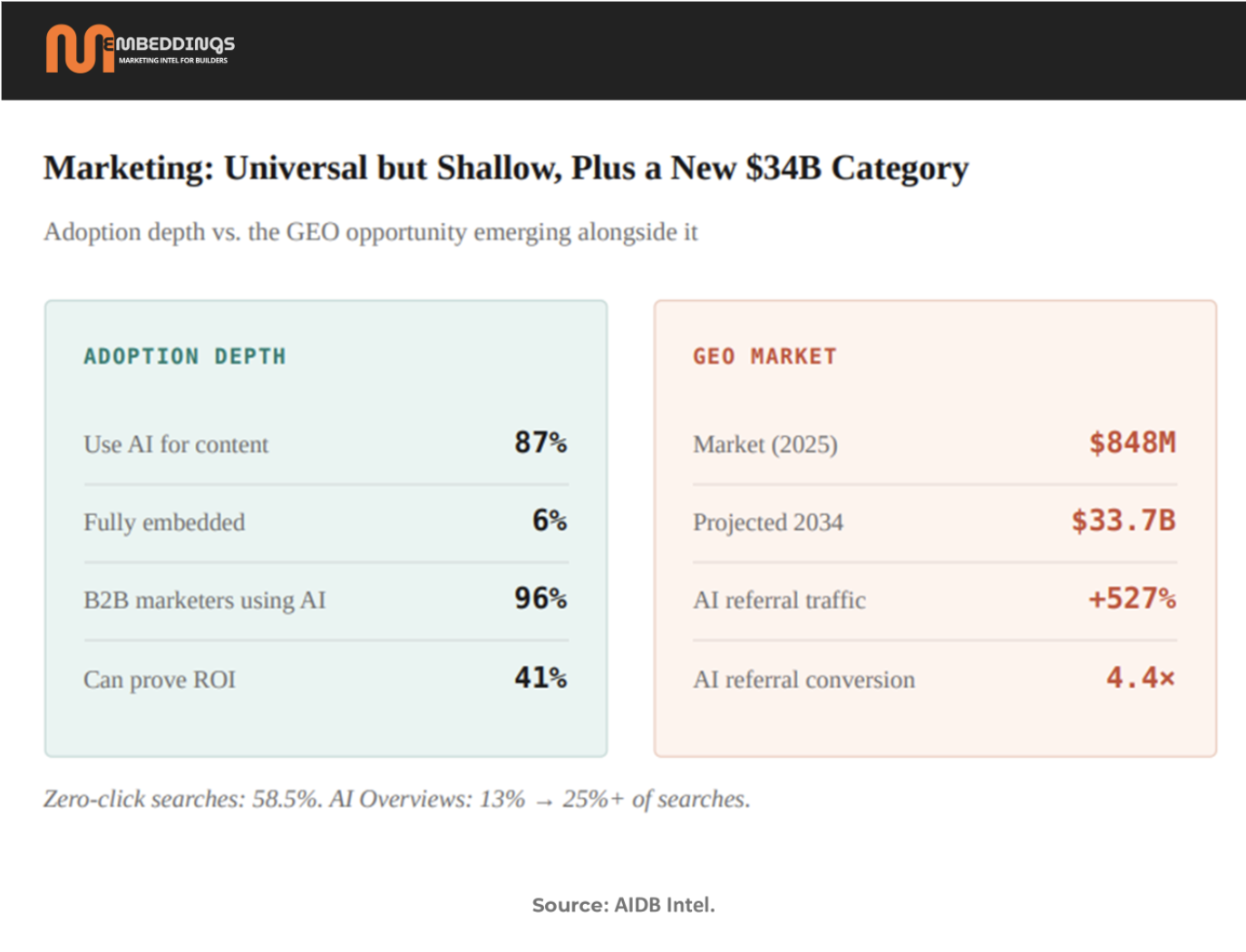
The GEO market — Generative Engine Optimization — was $848M in 2025. It's projected at $33.7B by 2034, a 50.5% CAGR. AI referral traffic is up 527%. AI referral conversion runs 4.4× traditional. Zero-click searches have hit 58.5%. AI Overviews went from 13% to over 25% of searches.
In other words: a $34 billion category is emerging in the space between where AI sends people and where brands show up. And the function most responsible for showing up — marketing — has an 81-point gap between adoption and depth.
This is not an awareness problem. 96% of B2B marketers are using AI. It's not a skepticism problem — only 0.6% of AI users say they don't see value. It's a depth problem. Marketing
adopted AI faster than almost any function and has less to show for it than almost any function because adoption was shallow. Content generation, not workflow transformation. Copilot, not infrastructure.
The uncomfortable implication: the marketers most likely to lose ground to GEO are the ones who think they've already adopted AI. They have. They just adopted the wrong layer of it.
THE GEO MARKET MAP
Twenty-five companies have raised more than $300M in 18 months to help brands manage their presence in AI search. The pitch is simple: consumers are shifting from Google to ChatGPT and Perplexity, your brand is invisible in AI-generated answers, and you need a tool to fix it. Gartner says organic traffic drops 25% by year-end. AI referral traffic grew 1,200% last year. The money is real.
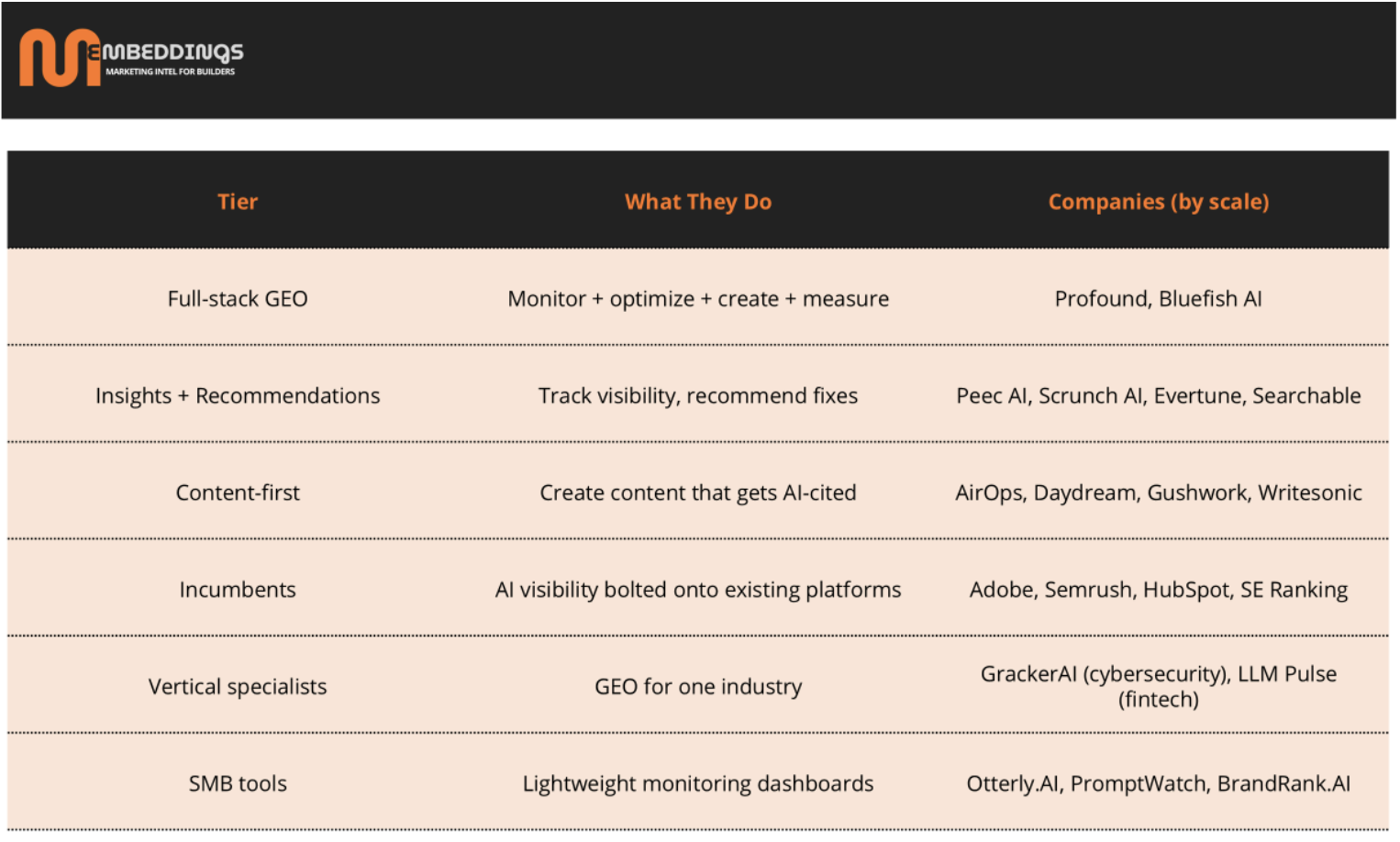
The problem is that most of these tools solve the easy part. Monitoring what AI says about you is a commodity — Adobe, Semrush, and HubSpot already ship it inside platforms you’re paying for. The hard part is changing the answer. And that requires a fundamentally different playbook than SEO. LLMs don’t rank pages. They synthesize trust signals: structured data, authoritative sourcing, third-party validation. Most GEO vendors are selling dashboards to a market that needs engines.
The stack is splitting into tiers — from full-stack platforms that monitor, optimize, create, and measure, down to $29/month dashboards that just watch. The gap between the top and bottom is enormous, and it’s widening.
Here’s the uncomfortable bet: half this market consolidates or dies within 18 months. Monitoring alone is indefensible. The incumbents will absorb it. The companies that survive will be the ones that close the loop — from insight to content to measurable citation. Everyone else is selling binoculars in a market that needs artillery.
