The $70B ad market you're probably ignoring , and Meta isn't
Meta had a busy week, and not the kind their comms team wanted. A privacy lawsuit over AI glasses footage sent to human reviewers in Kenya, a $50M/year content licensing deal with News Corp, and new retail media tools all dropped within days. Meanwhile, OpenAI is building a real ad business (Criteo is now in, Trade Desk talks moved markets), and ByteDance's video AI hit a wall. In the big picture section, we break down retail media's off-site growth and what Meta's latest tools tell us about where the market is heading. And we spotlight Rembrand, the company betting that AI-powered product placement becomes the next programmatic format.
Some of these themes, off-site growth, retail media measurement, and how AI is reshaping commerce, are coming up in sessions at SXSW this week. I'll be there. If you're in Austin, ping me.
Let's get into it.
Vas
Marketing & Advertising
1. OpenAI’s Ad Business Is Getting Real
Criteo became the first ad-tech partner in ChatGPT's ads pilot. Early data: LLM-referred users convert at 1.5x the rate of other channels. (Read more)
2. Meta is chasing retail media budgets
Two new tools in testing, SKU-level catalog optimization and incremental sales measurement, as Meta pushes into the $70B U.S. retail media market. (Read more)
AI & Content
3. Meta Signs $50M/Year AI Content Deal with News Corp
Three-year deal for WSJ, New York Post, and other brands, covering Meta AI responses and model training. The price of quality training data keeps climbing. (Read more)
4. ByteDance’s Seedance 2.0 Hits a WallMassive demand, hours-long wait times, and copyright complaints, all in one week. U.S. chip export restrictions are part of the bottleneck. (Read more)
AI & Trust
5. Meta's AI glasses are sending footage to human reviewers in Kenya
A Swedish investigation found contractors reviewing intimate footage from Ray-Ban Meta glasses. Meta now faces a U.S. lawsuit alleging 7M+ buyers were misled. (Read more)
BIG PICTURE

The AI Race for Retail Media's $70 Billion
Retail media is entering a more mature phase, and Meta's latest moves show exactly where the market is heading. What began as a way for retailers to monetize search results and sponsored product listings has become one of the most important growth engines in advertising. US retail media spend is projected at about $58.8 billion in 2025, rising to $69.3 billion in 2026, according to EMARKETER. McKinsey sees the broader US commerce media market topping $100 billion by 2027 as the model expands beyond traditional retailers into other transaction-rich environments.
The money is still coming primarily from three places: trade marketing budgets shifting into measurable media, performance budgets chasing high-intent shoppers, and an increasing share of brand budgets looking for better attribution. That mix explains why retail media has become so attractive: it sits close to the point of purchase, uses first-party transaction and loyalty data, and promises a tighter link between ad exposure and sales than open-web media can offer.
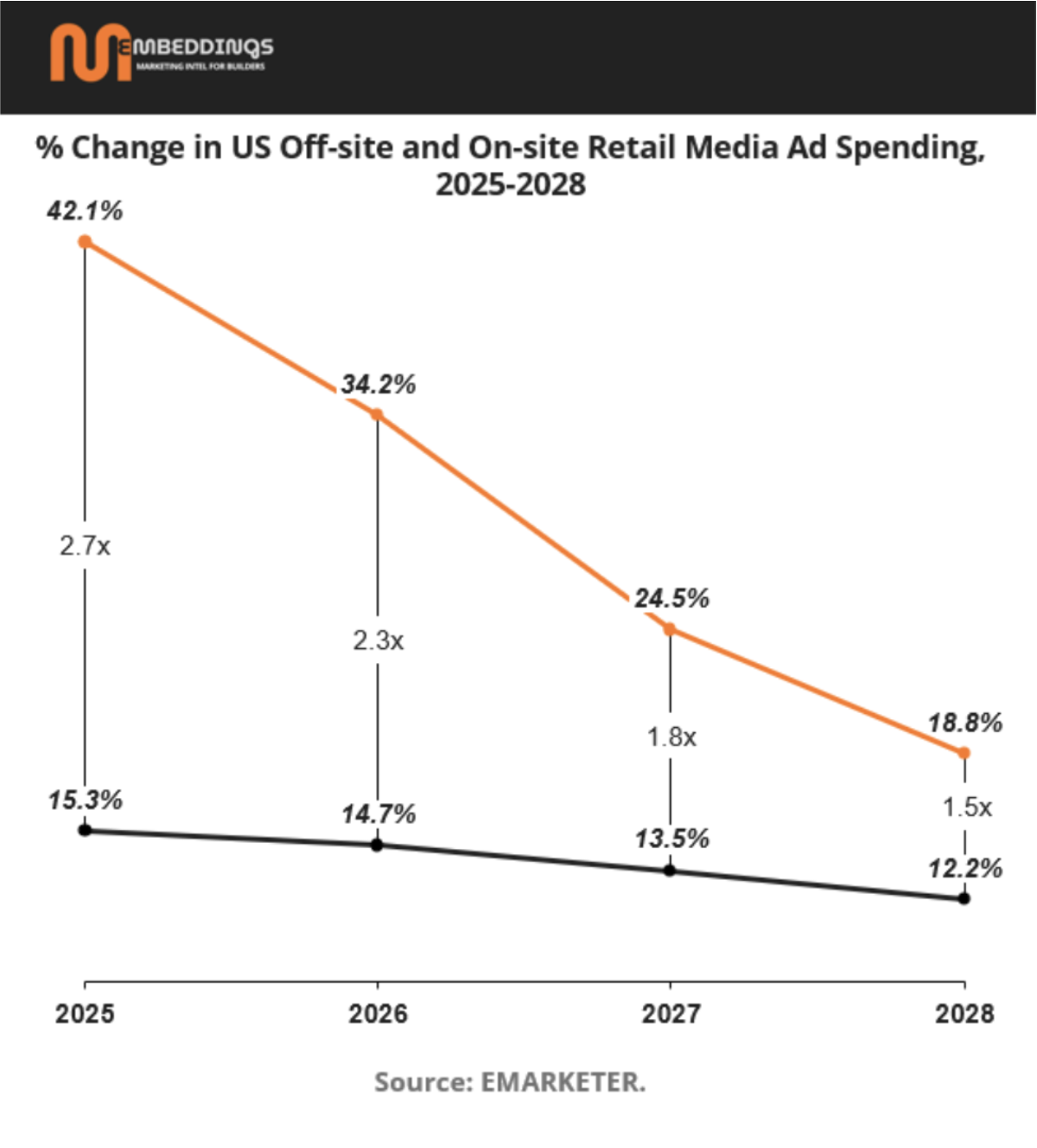
But the next phase of growth is not just inside retailer-owned sites and apps. Off-site retail media is growing much faster than on-site, with EMARKETER estimating 42.1% growth in off-site spend in 2025, versus 15.3% for on-site. That shift matters because it moves retail media beyond sponsored search and into social, video, CTV, and other environments where consumer attention actually lives.
Chart: Off-Site Retail Media Ad Spend Will Grow at 2x the Rate of On-Site Through 2026% change in US on- and off-site retail media ad spending, 2025–2028. Source: EMARKETER Forecast, Nov 2024.
That is where Meta comes in. Its new retail media tools, including product set optimization and product insights, are designed to help retail media networks optimize campaigns across groups of SKUs and measure whether SKU-level ad optimization drives incremental sales. In plain English, Meta is trying to become the off-site execution layer for retail media: the place where retailer data can power social advertising with the same precision that retailers offer on their own properties.
The AI angle is central. AI makes SKU-level optimization, creative variation, audience modeling, and omnichannel measurement possible at scale. Retail media is no longer just monetized shelf space; it is becoming an AI-driven commerce system. The winners will be the companies that can combine transaction data, media reach, and machine intelligence into one measurable loop.
Sources: Adweek
COMPANY FEATURE
Rembrand, The Case for Ads You Don't Skip (Because You Don't Notice Them)
The banner ad is 30 years old. Click-through rates have been below 1% for most of that time. Pre-roll ads get skipped in 5 seconds. Mid-rolls get muted. The entire digital advertising format is built on interruption, and consumers have gotten very good at ignoring it.
Omar Tawakol thinks the answer is to put the ad inside the content itself.
Tawakol isn't new to this. He built BlueKai, the world's largest data management platform, and sold it to Oracle. Then he built Voicea, a voice AI company, and sold it to Cisco. Now he's running Rembrand, a company that uses AI to insert branded products into existing video without reshooting a single frame.
How it works: Rembrand's AI reconstructs 2D video into a 3D environment, mapping camera angles, surfaces, lighting, and shadows. A branded product gets rendered into the scene to match the physics of the shot. What used to take a VFX team weeks now takes hours. And critically, it's non-generative, it uses real brand assets, not AI-hallucinated logos.
Where it's real today: Pepsi, L'Oreal, Charles Schwab, and Amazon are clients. 250 million paid views in 2024. Revenue grew 6x year-over-year. The company has raised $68.5M, with The Trade Desk as both investor and distribution partner , meaning programmatic buyers can activate virtual placements through the same platform they already use for CTV.
The consolidation play: In the last six months, Rembrand absorbed Mirriad's US operations , a UK-based competitor with an Academy Award for its VFX tech that ran out of cash , and acquired Spaceback, a social-to-CTV creative automation platform. Three companies, one stack. The combination gives them premium CTV publisher access (from Mirriad), a second product line (from Spaceback), and the AI speed advantage they already had.
The honest caveat: Today, 96% of Rembrand's placements are virtual billboards in transition scenes , not a Pepsi can seamlessly sitting on a character's desk in a drama. The technology works best in studio formats, talk shows, and outdoor shots. Getting into scripted premium content at scale means convincing Netflix, Disney+, and Hulu to open up their libraries , and they haven't yet. The US market is also behind Asia and the Middle East, where 10% of TV budgets already go to virtual product placement.
The bet is that programmatic distribution through The Trade Desk changes the math. If buying virtual placement becomes as easy as buying a pre-roll, budgets follow. If it stays a custom integration requiring publisher-by-publisher deals, it remains niche.
For CMOs spending on CTV, this is worth watching. Not because virtual product placement will replace your media plan , but because the format that consumers can't skip, mute, or block might be the one that actually works.
Marketing Embeddings is read by 20,000+ CMOs, CTOs, and media leaders navigating AI's impact on marketing. Forward this to someone who needs to see it.