The Agency Model Is Breaking from Both Ends
Good morning,
This week we're looking at how AI is showing up inside companies, not as strategy decks, but as operational decisions. Gucci tried AI creative and got dragged. Burger King is scoring employee politeness with AI headsets. Meta is grading everyone on AI usage in performance reviews.
The big piece this week is the agency model. 15,600 jobs cut across the major holding companies in 2025, and the MMA-BCG CMO Survey data shows where CMOs expect the work to shift. WPP's move to outcome-based pricing is the first real structural response.
And in the company spotlight, we're looking at Prescient AI, a team trying to rebuild marketing mix modeling from scratch for mid-market brands that could never afford it before.
Brands are experimenting, agencies are losing ground to tech, and the tools that used to be enterprise-only are going mainstream. The pieces are moving fast.
Let's get into it.
Vas-
NEWS
Marketing & Advertising
1. Gucci's AI Backlash at Milan Fashion Week
Gucci used AI-generated images to promote creative director Demna's debut runway at Milan Fashion Week, and the backlash was immediate. (Read more) Open in Chat GPT
2. Burger King's AI Politeness Monitor
Burger King is using an AI system called "Patty" to monitor employee politeness in real time. (Read more)
3. Meta Grades Employees on AI Usage
Meta is now grading every employee on "AI-driven impact." Starting 2026, performance reviews across all roles, engineers, marketers, designers , include how effectively you use AI to deliver results. It influences promotions, bonuses, and career trajectories. (Read more) Open in Chat GPT
Market & AI
4. The Citrini "2028 AI Crisis" Report
From thought experiment to reality in one week. Citrini Research's "2028 AI Crisis" report modeled a fictional scenario where AI-driven white-collar displacement triggers a doom loop, then a real sell off happens, then Block cuts 40% of his staff, then rumors of market manipulation emerge. (Read more)
5. The Pentagon vs. Anthropic
The Pentagon vs. Anthropic saga unfolded fast. The US Government blacklisted Claude from all federal agencies, hours later, OpenAI announced a $200M Pentagon deal, then consumers pushed Claude to #1 on Apples App store overtaking ChatGPT. (Read more)
BIG PICTURE
The Agency Model Is Breaking , From Both Ends
The agency shift we covered in December is accelerating. The advertising market grew 8.6% worldwide last year. Agency holding company revenues fell 1.2%. The money is still there. It's just flowing around agencies, not through them.
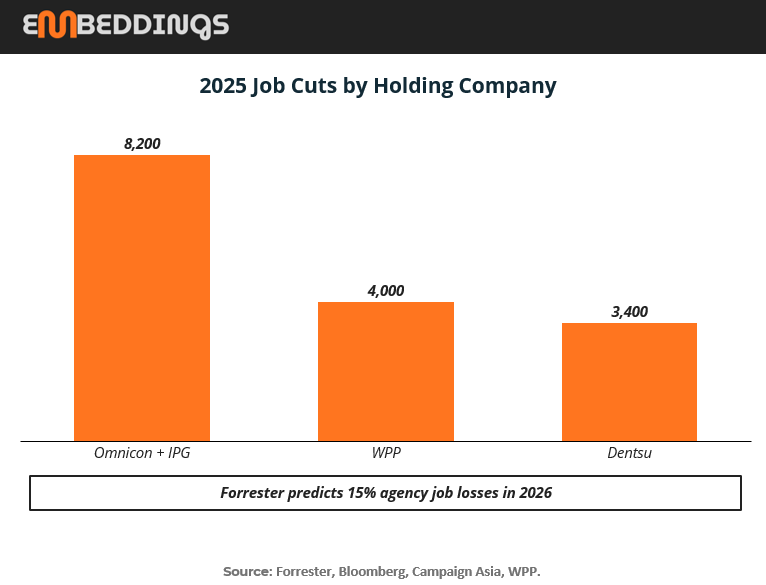
The headcount numbers tell the story:
Omnicom + IPG jointly cut 8,200 roles in 2025. Omnicom doubled its synergy target to $1.5B.
WPP cut ~4,000 roles. Revenue down 3.6% organically.
Dentsu cut 3,400 jobs and posted a record $2.2B net loss for the full year.
Forrester predicts 15% of agency jobs will be eliminated in 2026 , following 8% cuts in 2025.
Sources: Campaign Asia | WPP | Bloomberg/PPC Land | Forrester/The Drum
And brands aren't waiting. Coca-Cola used 5 AI specialists to produce 70,000 video clips in 30 days, work that previously required a 50+ person crew. Shopify's CEO told employees to "prove why AI can't do the job" before requesting headcount. The production economics that justified agency fees are collapsing in real time.
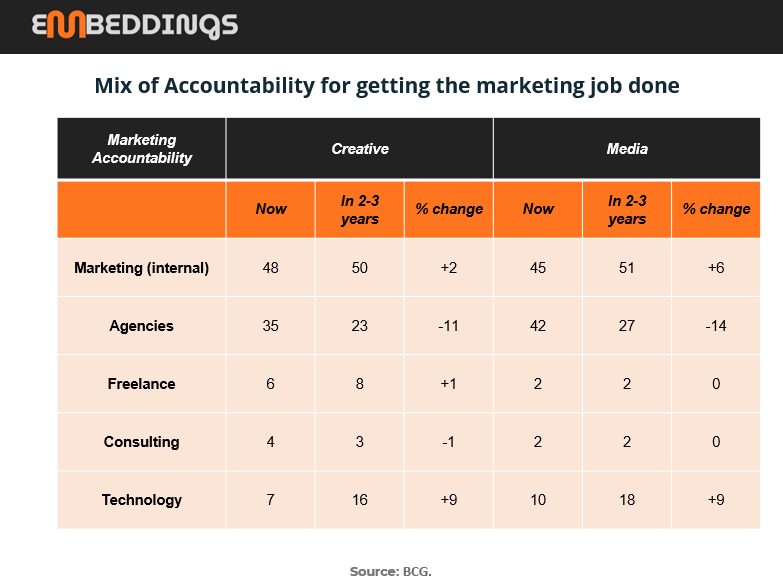
CMOs see where this is heading. In the MMA-BCG CMO Survey, they expect agency accountability to drop sharply in the next 2-3 years, creative agency share falls from 35% to 23% (-11 pts), media agency share from 42% to 27% (-14 pts). Where does that work go? Technology, jumping from 7% to 16% on the creative side and 10% to 18% on media (+9 pts each). The shift isn't from agencies to in-house. It's from agencies to technology.
So, what does survival look like? WPP is betting it looks like outcomes. This week, the world's largest agency group announced it's piloting outcome-based pricing with Jaguar Land Rover, fees tied to sales results, not hours billed. Global client leaders will now be compensated on client growth, not agency P&L. For a U.S. retailer, WPP's platform reportedly generated £300M in incremental sales. CEO Cindy Rose called it "the beginning of a more widespread commercial model evolution."
It's the right instinct. When AI compresses production to near-zero and CMOs are already shifting accountability to technology, the only thing left to charge for is results. The agencies that figure out how to prove, and get paid for, business outcomes will survive. Everyone else is billing hours for work AI can do in minutes.
Sources: Digiday | MMA-BCG CMO Survey | Forrester | EMARKETER
COMPANY FEATURE
Prescient AI, The 60-Year-Old Model Your Media Team Still Relies On
Marketing mix modeling was invented in the 1960s. Regression analysis. Monthly data. Massive consulting fees. Results that arrived too late to act on.
Six decades later, most brands still use some version of the same math. Prescient AI is betting that's over.
The Miami-based company (founded 2020, $17.7M raised, $11.4M in revenue) built a daily-updating MMM platform from scratch, not a wrapper on legacy regression, not an open-source fork. Their pitch: marketing measurement that moves at the speed media buyers actually work.
What's different in practice:
Daily, not monthly. Models refresh every day at the campaign level. Media buyers can reallocate spend mid-flight, not post-mortem.
Halo effects measured. A TikTok awareness campaign lifts organic search and direct traffic. Most tools can't connect those dots. Prescient claims to.
48 hours to first insight. Traditional MMM engagements take weeks to months. Prescient onboards in 10 minutes.
Platform-agnostic. Not built by Meta or Google, so recommendations don't favor the house.
Traction: HexClad reported 85% more revenue and 30% ROAS increase. Other named clients include Jones Road Beauty, Saatva, Good American, and Beekman 1802. The company won Predictive Modeling Solution of the Year at the 2025 AI Breakthrough Awards.
The caveat: Prescient's sweet spot is DTC brands spending $1M–$50M on media. It's not competing with Nielsen or Analytic Partners for P&G's budget. The "first new MMM since the 1960s" claim stretches, Recast, Lifesight, and others have also modernized the approach.
But the underlying trend is real: AI is democratizing marketing measurement. Tools that used to require seven-figure budgets and data science teams are becoming self-serve SaaS. For mid-market brands, that changes everything.
The question isn't whether MMM needed an update. It's whether the update goes far enough.