
Anthropic spent $8M on ads to say they don't do ads
This week, the AI arms race is shifting to advertising and differentiation and SuperBowl gives us one of the clearest signals of a real inflection point: AI has stopped being a curiosity category. It’s becoming a segmented consumer market where brand identity matters as much as product capability.
In the news, Reddit is signaling its next growth engine: merging traditional search with AI-powered discovery into a unified product that could unlock a major new revenue stream. Meta is pushing deeper into AI-native media, testing a standalone Vibes video app while quietly exploring subscription economics. And on the model front, the agentic coding war is accelerating fast, OpenAI introduced GPT-5.3-Codex as its most advanced “computer-using” coding agent yet, while Anthropic launched Claude Opus 4.6, doubling down on longer task endurance and higher-quality professional outputs.
And in our Company Profile, we feature DaVinci Commerce, a company betting that the next retail media advantage won’t come from better strategy decks, it will come from automating the operational chaos across 50+ retail media networks. It’s a positioning-heavy issue because in 2026, awareness isn’t the bottleneck anymore. Differentiation is.
— The Marketing Embeddings Team
NEWS
Reddit said unifying traditional and AI-powered search could become its next major product and revenue driver. (Read more)
Meta is testing a standalone app for its AI-generated Vibes videos while exploring subscriptions. (Read more)
OpenAI announced GPT-5.3-Codex—positioning it as their most capable agentic coding model so far, and a step toward Codex doing full-spectrum professional work on a computer (not just writing and reviewing code). (Read more)
Anthropic announced the launch of Claude Opus 4.6, its latest artificial intelligence model that’s better at coding, sustaining tasks for longer and creating higher-quality professional work products and outputs (Read more)
BIG PICTURE
The AI Arms Race Has a New Battlefield: Your Attention
The AI arms race has shifted from a battle of raw capability to a fight for distribution and brand differentiation, and this year’s Super Bowl was the inflection point. No company signaled this new era more clearly than Anthropic.
With a series of witty, satirical ads, Anthropic didn’t just introduce its AI, Claude; it drew a line in the sand. By attacking the ad-supported models of its competitors with the tagline, “Ads are coming to AI. But not to Claude,” the company made a bold play for differentiation, selling a philosophy of privacy and focus, not just a product. This move is emblematic of a much larger trend: the era of simply building awareness for AI is over, and the fight for market share has begun.
The Soaring Cost of Attention
Taking a step back from the Super Bowl, the broader data reveals a dramatic increase in marketing investment across the AI sector. Consider these key data points:
Over $1 Billion in Digital Ads: In 2025 alone, generative AI platforms spent more than $1 billion on digital advertising in the U.S., a staggering 126% increase from the previous year
Explosive Growth from Tech Giants: In January 2026, digital ad spending by Google and Microsoft to promote their AI products skyrocketed by approximately 495% compared to the same month a year earlier
The Rise of Influencer Marketing: The battle for distribution has also extended to creators. Tech giants are now paying influencers between $400,000 and $600,000 for long-term partnerships to promote their AI tools, with some individual posts commanding up to $100,000
This surge in spending indicates that the primary challenge is no longer just innovation, but market penetration and building a distinct brand identity that resonates with specific user segments.
The New Map of AI Competition
This fight for differentiation was on full display during the Super Bowl. By analyzing the messaging of the major players, we can map out the new competitive landscape. The following chart plots each company based on their ad’s appeal (Emotional vs. Functional) and their target audience (Universal vs. Niche).
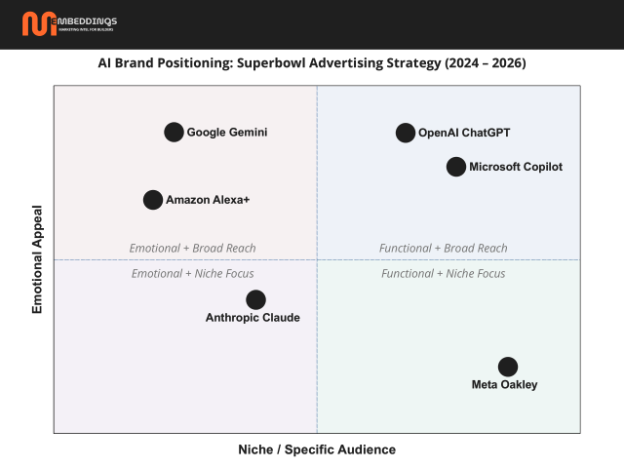
Here is how each company is positioning itself in this new market:
The Functional Powerhouses (OpenAI & Microsoft): These companies are competing on capability for a universal audience. Their ads showcased their AI as a powerful tool to enhance productivity and creativity for anyone, positioning their products as essential partners for work and life.
The Emotional Connectors (Google & Amazon): This group is vying for the heart, also for a universal audience. Google presented a heartwarming story of its AI helping a family, while Amazon used humor and a major celebrity to make its AI feel approachable and entertaining.
The Niche Specialist (Meta): Meta has carved out a specific territory by targeting a niche audience (athletes) with a purely functional appeal. Its ad demonstrated its AI-powered glasses as a hands-free tool for capturing performance, avoiding direct competition with the general-purpose players.
The Principled Rebel (Anthropic): As mentioned, Anthropic is using an emotional appeal for a niche audience that values privacy. Its anti-advertising stance is its core differentiator, a direct challenge to the prevailing business models.
The conclusion is clear: as the technology becomes a commodity, the ability to build a brand, tell a story, and capture a specific segment of the market will determine the ultimate winners in the next phase of the AI revolution.
COMPANY PROFILE
Worth Your Attention: DaVinci Commerce
Retail media was supposed to simplify commerce advertising. Instead, it fractured it.
More than 50 retail media networks now operate globally, each with its own creative specs, compliance rules, and approval workflows. For brands running campaigns across Walmart, Target, Kroger, and Amazon, scale doesn’t compound—it multiplies friction.
DaVinci Commerce is betting that this mess is fundamentally operational, not strategic—and that agentic AI can clean it up.
Formerly known as Jivox, the company has rebranded around a new thesis: retail media doesn’t need better dashboards. It needs autonomous systems that do the work humans are currently stitching together by hand.
The Operational Bottleneck in Retail Media
Creative variation, SKU swaps, retailer-specific sizing, and compliance reviews are still largely manual. Every network introduces new edge cases, and “compliance” often lives in PDFs, inboxes, or informal retailer relationships rather than machine-readable rules.
That creates a ceiling on scale where teams spend more time adapting assets than optimizing performance.
DaVinci’s core claim is that this layer -is now automatable.
How DaVinci Approaches the Problem
Rather than deploying a single general-purpose assistant, DaVinci uses a multi-agent architecture. Different AI agents are responsible for discrete tasks: creative generation, compliance validation, personalization, and SKU logic tied to inventory.
Upload a base asset, and the system generates retailer-specific variants, flags violations before submission, and dynamically adapts creative based on product availability. In theory, this turns retail media execution into a parallelized workflow rather than a serial one.
The design choice matters. Specialized agents reflect a broader pattern emerging in enterprise AI: narrow systems outperforming monolithic copilots when reliability matters.
A Rebrand With Implications
DaVinci Commerce is not a startup born in the GenAI era. It’s the evolution of Jivox, a DCO platform founded in 2007. The company has raised ~$33M to date and employs roughly 200 people, with recent funding directed toward scaling its AI-native platform.
That history cuts both ways. On one hand, DaVinci brings deep institutional knowledge of creative automation. On the other hand, the shift to “agentic AI” raises a familiar question: is this a true architectural leap, or a repositioning of existing capabilities under a new label?
Why It’s Worth Watching
DaVinci claims a 92% reduction in costs and 76% faster compliance cycles in a CPG case study. Those numbers aren’t independently verified, and customer use cases remain lightly detailed despite recognizable logos like PayPal and Nordstrom.
Still, the underlying idea is sound. Retail media’s growth has outpaced its tooling. Execution, not strategy, is the constraint. If agentic systems can reliably absorb retailer-specific chaos, they don’t just save time,they unlock scale that teams currently can’t reach.
