The 3% problem: While top performers scale AI, everyone else holds steady.
Last week, Anthropic raised $30B at a $380B valuation. IBM announced it's tripling entry-level hiring. Two very different bets on where AI lands.
In News, we unpack both, plus Anthropic's Super Bowl play that pushed Claude into the App Store's top 10, OpenAI hiring the founder of OpenClaw to accelerate personal agents, and French adtech startup Vibe raising €42M to scale generative media buying.
In Big Picture, the investment data backs up the pattern. Over a quarter of top-performing companies plan to increase tech budgets by 10%+ next year. Among everyone else? Just 3%. The race isn't about experimenting with AI anymore — it's about embedding it into infrastructure, workflows, and measurement systems that compound.
And in Company Profile, we spotlight Fibr.ai, an AI-native landing page optimization platform betting that the biggest leak in paid marketing isn't targeting, it's what happens after the click.
Until next week,
Vas & the Marketing Embeddings team
NEWS
Anthropic’s Super Bowl ads mocking AI with ads helped push Claude’s app into the top 10 on the U.S. App Store, driving a surge in downloads and user engagement for the Claude chatbot. (Read more)
Anthropic raised $30 billion in a Series G round at a $380 billion post-money valuation, reinforcing its position among leading AI labs. (Read more)
French adtech startup Vibe.co raised €42 M in Series B, enhancing its generative and agentic capabilities for media buying and creative production while expanding yield management tools for publishers. The company will also invest in deeper integrations with streaming partners and measurement providers as it scales across the U.S. (Read more)
IBM announced it will triple U.S. entry-level hiring in 2026 across all departments, redesigning junior roles to focus on strategic and customer-facing work rather than AI-automatable tasks. The company views this as a long-term talent strategy to avoid future mid-level management shortages and reduce costly external hiring, betting that AI-augmented employees will drive greater productivity and leadership depth over time. (Read more)
OpenAI hired Peter Steinberger, founder of the viral AI assistant OpenClaw, to help build its next generation of personal AI agents. Steinberger said joining OpenAI is the fastest way to scale the technology globally, while OpenClaw will transition to a foundation model and remain open source with OpenAI sponsoring its development. (Read more)
BIG PICTURE

AI Investment Is Accelerating, But So Are the Gaps
Two signals are shaping the future of AI in marketing: who’s increasing investment and what’s holding teams back.
The divide is striking: More than a quarter of top-performing companies plan to increase tech budgets by more than 10% in 2026. Among the majority of companies, just 3% say the same.
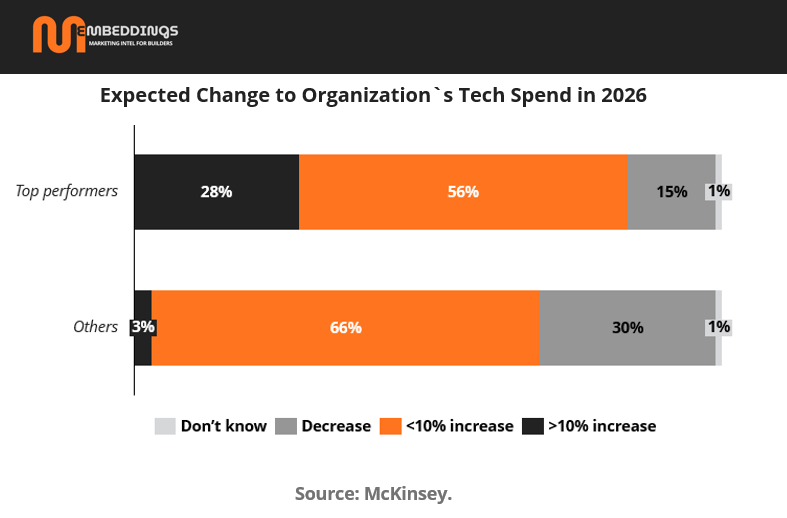
That’s not a marginal difference, it’s a strategic one.
Top performers aren’t treating AI as an experiment. They’re scaling infrastructure, upgrading data systems, and embedding AI deeper into core operations. Meanwhile, most organizations are either maintaining budgets or making modest increases.
For marketers, this signals something important: There is a fork on the road and the time to invest is now: AI advantage is about testing a few AI tools but about building systems, integrated martech stacks, strong data foundations, workflow automation, and better experimentation frameworks. The companies investing meaningfully now are building compounding advantages.
But there’s friction.
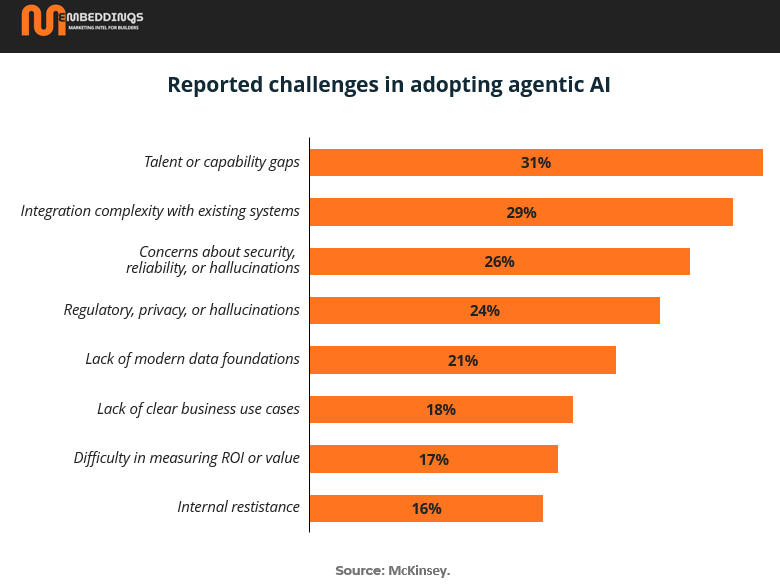
Nearly a third of respondents cite talent or capability gaps as their biggest challenge in adopting agentic AI. Close behind: integration complexity, security concerns, and regulatory risk.
In other words, money alone isn’t the bottleneck.
Many marketing teams still lack deeper AI fluency. Tools don’t connect cleanly with existing workflows. Legal and compliance slow deployment. And measuring ROI remains difficult.
This creates a paradox:
The leaders are accelerating investment.
But many organizations are still stuck figuring out how to operationalize AI effectively.
What This Means for Marketers
Investment is necessary, but insufficient. Without capability development, spend won’t translate into advantage.
Talent strategy matters. Upskilling teams in AI workflows, automation, and experimentation may deliver more impact than adding another tool.
Integration is the real battlefield. The winners won’t use the most AI, they’ll embed it most effectively into CRM, analytics, content, and paid systems.
Measurement is critical. If AI initiatives can’t be tied to performance outcomes, executive support will fade.
The takeaway: the AI race isn’t slowing down, it’s separating leaders from laggards.
2025 was about experimentation.
2026 looks like the year AI becomes operational infrastructure.
And infrastructure compounds.
COMPANY PROFILE: FIBR.AI
The Problem
Marketers spend fortunes on hyper-targeted ads, segmented by intent, behavior, and demographics, then send every click to the same static landing page. It’s the biggest leak in the funnel, and everyone knows it. Historically, fixing it meant engineering resources, complex experimentation tools, or expensive agency retainers, luxuries reserved for the largest brands. So most marketers just… don’t personalize.
How it Works
Fibr.ai drops a layer on top of your existing site. Three AI agents handle the work: running dynamic A/B tests, personalizing content per visitor (copy, imagery, layout), and optimizing autonomously over time. Connect your ad platforms and analytics, and the agents start tailoring landing pages to match visitor intent, no engineering tickets, no page builders. It treats each URL as a living system that learns, not a static asset.
Landscape
The website personalization market ($2.6B in 2025, projected $6.6B by 2029) is consolidating quickly. The previous generation of pure-play tools has largely been absorbed, Mastercard acquired Dynamic Yield, and Webflow acquired Intellimize in 2024. Experimentation incumbents like Optimizely and VWO are adding AI features, but they aren’t AI-native.
Mutiny ($72M raised, $600M valuation) is the closest pure-play comp, but it’s B2B-focused, hasn’t raised since its 2022 Series B, and is expanding into a broader “AI agent for customer-facing workflows.” Adobe Target and SAP Emarsys serve the enterprise segment but require heavy implementation and technical resources.
The Numbers
Fibr has raised $9.5M across three funding rounds, with Accel doubling down in a $5.7M round in February 2026. The company was founded by Pritam Roy and Ankur Goyal. It is seeing early enterprise traction in banking and healthcare, with the CEO targeting $5M in ARR and approximately 50 enterprise customers. On Tracxn, Fibr ranks 10th among 348 active competitors, 33 of which are funded.
Marketing Embeddings Take
The ad-to-landing-page gap is real, expensive, and well-documented, every marketer knows the problem. The question is whether Fibr's timing and positioning can outrun the consolidation wave. The previous generation of personalization startups ended up as features inside larger platforms (Dynamic Yield → Mastercard, Intellimize → Webflow). Fibr's agentic architecture, three specialized agents vs. one optimization engine, is a genuine differentiator, but architecture alone doesn't build a moat. Proof about results will. Industry bodies like MMA Global have already validated the business case for AI personalization when it comes to AI personalization and creative delivery, (on average 2X), and that is before personalization is applied on the landing page. Adding that last piece could be transformational. Alsot: the no-code, pay-as-you-go model opens mid-market doors that Adobe and Optimizely can't reach without an enterprise sales cycle - although it may not be realistic for enterprise. Watch two things: can autonomous optimization deliver with thin traffic (most mid-market sites aren't running millions of sessions), and will enterprise customers trust AI agents rewriting their landing pages without a human in the loop? Most useful for performance marketing teams running paid at scale. If the consolidation thesis is right, Fibr either becomes the next acquisition target or the one that breaks through.
Each week we are reviewing the most interesting companies in marketing and AI. If you are interested in featuring your company in a Marketing Embeddings issue please reach out here.