AI Is Moving from Experiments to Systems
Good morning,
Hard to believe, but the momentum keeps accelerating, this week brought new releases across agentic AI, world models, and autonomous systems, and every step forward is exposing new questions around control, security, and where real value gets captured.
In the news, we’re tracking AI’s expansion across three fronts at once. World models are moving from research to experience, with Google DeepMind’s Project Genie hinting at how interactive 3D environments could redefine games and simulations. Generative media is getting closer to developers, as xAI opens up text-to-video tools through Grok Imagine. Open-source models continue to narrow the gap with proprietary leaders, while Google pushes agentic browsing directly into Chrome, embedding autonomy into the most familiar interface on the internet. At the same time, security researchers are raising flags about what happens when agents like OpenClaw act in the real world without mature safeguards.
In What Works, we look at creative intelligence crossing a threshold. This is no longer experimental spend, it’s becoming measurable, governable infrastructure that CMOs can fund, defend, and scale. The data makes it clear: CI is taking share not because budgets are exploding, but because it compounds value across campaigns and markets.
And in this week’s Company Profile, we spotlight DaVinci Commerce, a rebranded veteran betting that the biggest problem in retail media isn’t strategy, it’s execution. As agentic systems move into compliance, SKU logic, and creative adaptation, the question isn’t whether retail media grows, but whether automation can finally absorb the operational chaos holding it back.
It’s an issue about scale, what enables it, what constrains it, and what breaks when AI moves faster than the systems meant to contain it.
— The Marketing Embeddings Team
NEWS
Google DeepMind unveiled Project Genie, an experimental AI system that lets users generate and explore interactive 3D worlds from text and images. The demo highlights how world models could power the next wave of games, simulations, and immersive AI experiences.(Read more)
xAI released the Grok Imagine API, giving developers access to text-to-video generation and visual editing tools. The launch pushes generative video further into the developer ecosystem and signals rising competition in AI-powered media creation.(Read more)
Moonshot AI introduced Kimi K2.5, positioning it as the most powerful open-source LLM to date. With agent orchestration, massive context windows, and strong benchmarks, it raises the bar for open-weight models competing with proprietary leaders. (Read more)
Google is adding Gemini-powered auto-browsing to Chrome, allowing the AI to navigate websites, research topics, and complete tasks autonomously. The feature underscores Google’s push toward agentic browsing embedded directly into everyday productivity tools. (Read more)
Security researchers are raising alarms around OpenClaw, a viral AI agent platform accused of weak safeguards and exploitable extensions. The case highlights growing risks as autonomous agents interact with real-world systems without robust security controls. (Read more)
WHAT WORKS

Creative Intelligence is no longer sitting in the innovation bucket. It is becoming a line item that CMOs can defend, scale, and measure. The two charts below make that shift unmistakable and point to where leading teams are already finding leverage.
Creative intelligence is graduating from test budgets to real money
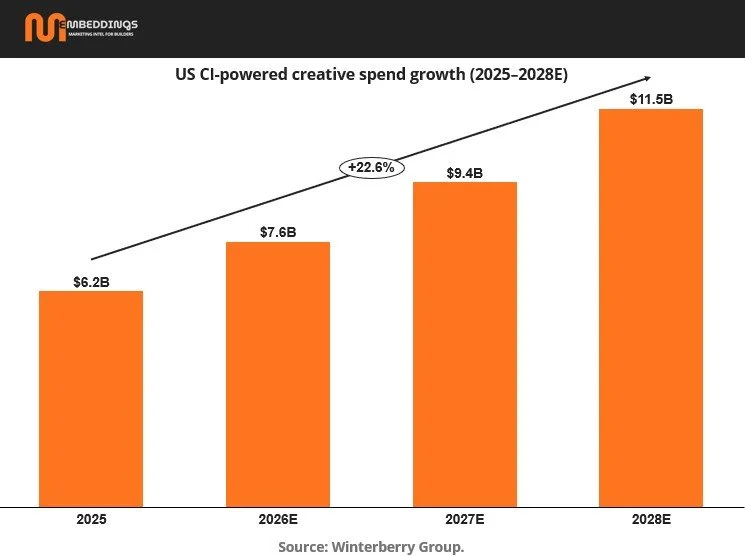
The first chart shows US creative intelligence powered creative spend growing from roughly $6.2B in 2025 to about $11.5B by 2028. That implies growth north of twenty percent annually, far outpacing most other marketing technology categories.
What matters is not just the growth rate but the absolute dollars. This is no longer pilot spend tucked inside innovation or analytics budgets. By 2028, creative intelligence is large enough to force structural decisions about ownership, integration, and accountability.
What works in practice is treating CI as a productivity and performance system. Teams that succeed do not position it as better reporting. They frame it as a way to reduce wasted production, shorten learning cycles, and systematically improve asset performance across channels. That framing unlocks larger budgets because it ties directly to efficiency and outcomes rather than curiosity.
For CMOs, the signal is clear. If creative intelligence is still funded as an experiment, it is already lagging the market.
CI is taking share because it compounds value, not because total spend is exploding
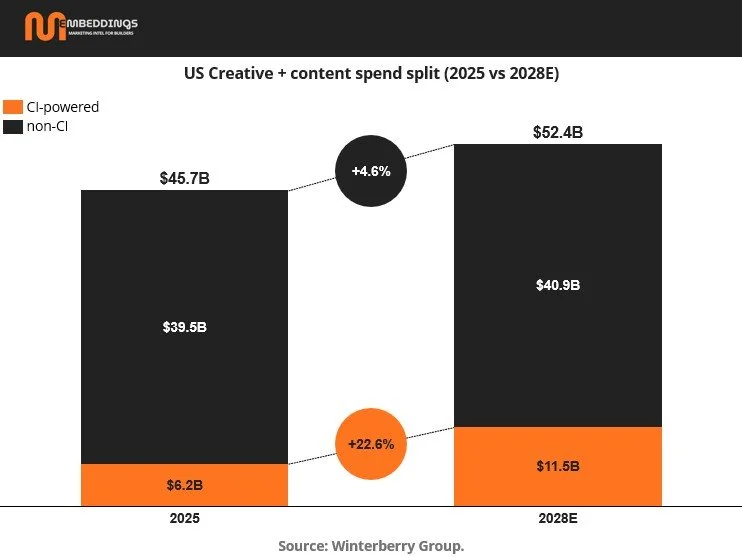
The second chart shows total US creative and content spend growing modestly from about $45.7B in 2025 to $52.4B in 2028. Within that relatively stable pool, CI powered spend nearly doubles, while non CI spend grows only marginally.
This is the most important insight. Creative intelligence is not riding a rising tide of overall budgets. It is taking share by proving it can make existing spend work harder.
What works for leading organizations is using CI to industrialize learning. High performing teams connect creative attributes to performance outcomes, feed those insights back into briefs, and reuse proven patterns across campaigns and markets. Over time, creativity stops being a series of disconnected bets and starts behaving like a managed growth system.
The result is compounding returns. Each campaign improves the next one. Each market benefits from learnings generated elsewhere. That is why CI earns budget reallocation even when total spend growth is constrained.
The practical takeaway for CMOs
Creative intelligence works when it is treated as infrastructure, not insight theater. The budgets are moving toward teams that operationalize creative learning, embed it into paid media workflows, and use it to make faster and better decisions at scale.
The charts make one thing unavoidable. Creative is becoming measurable in ways it never was before. And once it is measurable, it becomes governable, optimizable, and fundable like any other performance lever.
COMPANY PROFILE
Day.ai: AI-Native CRM
Day.ai is building a CRM from scratch for an AI-native world. Founded in May 2023 by two HubSpot veterans — Christopher O'Donnell (former CPO) and Michael Pici — the company recently raised a $20M Series A led by Sequoia, bringing total funding to $24M.
What It Does
The product, called CRMx, auto-ingests data from emails, meetings, Slack, and call transcripts. No manual entry required. Users interact through a conversational interface, asking questions like "why is this deal stalling?" rather than building reports.
The system generates daily priorities, meeting prep, and follow-up suggestions. O'Donnell describes the vision as "the Waymo of CRM" — fully autonomous.
The Thesis
Traditional CRMs require humans to maintain them. Sales reps spend significant time on data entry, and the data is often incomplete or stale anyway. Day.ai flips the model: the system maintains itself by capturing interactions automatically and reasoning over unstructured data.
For startups, it replaces the CRM entirely. For larger companies, it can sit alongside existing systems.
Current State
After 1+ year of private testing, the company has around 120 customers. Still early.
Marketing Relevance
CRM data quality directly impacts marketing attribution and sales-marketing alignment. A self-maintaining CRM could improve handoff visibility and reduce the "black hole" problem where leads disappear after passing to sales.
Whether Day.ai delivers on this remains to be seen. The technical challenge — accurately capturing and contextualizing unstructured data across multiple sources — is significant.
Open Questions
Can automated data capture match the accuracy of (well-maintained) manual entry?
How does it handle edge cases, corrections, and data governance?
Will enterprises trust AI-generated CRM records for forecasting and reporting?
At 120 customers, product-market fit is still being proven
Bottom Line
Day.ai represents a broader trend: rebuilding core business software for AI agents rather than adding AI features to legacy systems. The CRM category is a logical starting point given its data entry pain points. The founders have relevant pedigree. Sequoia's backing adds credibility.
Execution will determine whether "self-driving CRM" is a real category or a funding pitch.