Signals structural change, not tactics
Good morning,
This week, the signal isn’t coming from a single breakthrough, it’s coming from friction. AI is pushing deeper into everyday workflows, but not without resistance from platforms, marketplaces, and users trying to reassert control.
In the news, we’re tracking a widening gap between what AI can do and what it’s allowed to do. Autonomous coding agents are sparking fresh debate about how fast jobs could be displaced. Anthropic is embedding Claude directly into Excel, pulling AI further into the core of enterprise productivity. At the same time, eBay is drawing a hard line, banning AI shopping agents outright, while ElevenLabs expands from voice into full-fledged music generation.
In the Big Picture, we zoom out. New data from Moloco and BCG makes one thing clear: AI isn’t just changing marketing tactics, it’s reshaping which businesses are structurally positioned to survive. As discovery collapses into AI-mediated decisions, vertical exposure and customer relationships matter more than channels or creative ever did.
And in this week’s Company Profile, we introduce Unusual, a startup tackling a new and largely invisible problem: how AI models perceive brands. As LLMs increasingly shape shortlists and recommendations, Unusual is betting that the next frontier of marketing isn’t SEO or ads, but influencing how AI systems internally reason about companies in the first place.
— The Marketing Embeddings Team
NEWS
Anthropic CEO claims software engineers could be replaced within months, as autonomous coding agents rapidly improve. The comment reignites debate around AI-driven workforce disruption and how fast enterprises may adopt fully automated development. (Read more)
Anthropic is opening access to Claude inside Excel, allowing users to analyze data, write formulas, and debug spreadsheets using natural language. The move signals AI’s growing role in everyday enterprise productivity tools. (Read more)
eBay has officially banned AI shopping agents from autonomously browsing and purchasing on its platform. The decision highlights growing tension between marketplaces and the rise of agentic commerce. (Read more)
ElevenLabs is expanding beyond voice with a new AI music generation platform, enabling creators to produce full tracks from text prompts. The launch positions the company deeper in the creator economy and generative media stack. (Read more)
Duolingo teamed up with Bad Bunny to launch a Spanish crash course ahead of Super Bowl 60, blending pop culture with language learning. It’s another example of how brands are using entertainment-driven education to boost engagement. (Read more)
BIG PICTURE
AI Isn’t Just Changing Marketing, It’s Rewiring Which Businesses Survive It

Most conversations about AI in marketing fixate on tools: creative generation, bidding automation, synthetic audiences. The Moloco–BCG AI Disruption Index reframes the issue entirely. AI is not primarily a martech upgrade it is a structural shock to how entire verticals create, capture, and defend demand. (Read the Report)
The report’s core insight is blunt: the biggest shifts in AI today aren’t technological they’re behavioral . Consumers are moving faster than marketing budgets, faster than org charts, and faster than most brand strategies.
What We Know
1. Not all industries are equally exposed and the gap is widening.
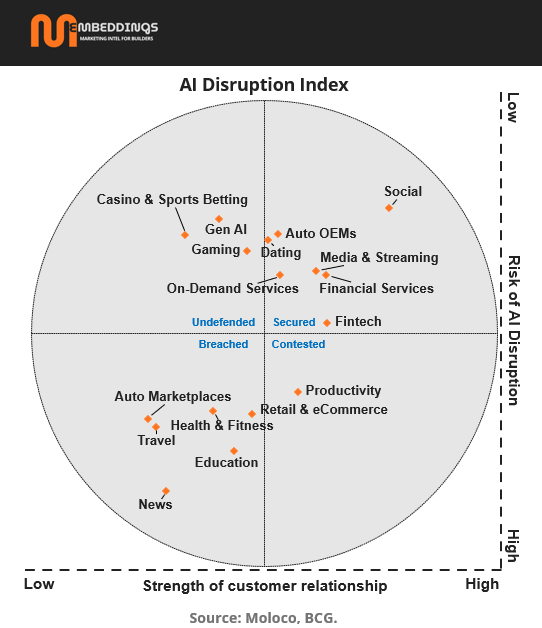
The AI Disruption Index maps verticals across two axes:
Risk of AI disruption (from discovery and service replacement)
Strength of customer relationships
The result is four strategic positions:
Breached (high AI risk, weak relationships): Travel, News, Auto Marketplaces. These sectors face direct disintermediation as AI summarizes, books, compares, and decides on behalf of users.
Contested (high AI risk, strong relationships): Productivity, Retail & eCommerce. AI can replicate workflows and shopping flows, but loyalty and embedded usage buy time.
Undefended (low AI risk today, weak relationships): Education, Health & Fitness. Core services may survive, but reliance on disrupted channels creates long-term fragility.
Secured (low AI risk, strong relationships): Financial Services, Social, Media & Streaming. Regulatory moats, content rights, and habitual usage create structural resilience.
The takeaway for marketers is uncomfortable: channel strategy is no longer enough. Vertical position now matters as much as creative, targeting, or attribution.
2. Customer relationships not reach are the durable asset.
Across every vertical, BCG and Moloco arrive at the same strategic principle:
“Customer relationships are the durable asset of the AI future.”
When AI can intercept demand before a click, before a visit, and even before a conscious choice, the only defensible advantage is a direct, trusted, habitual connection with the customer usually mediated through owned surfaces like apps, accounts, and logged-in environments.
What We Don’t Know
Despite the clarity of the framework, major uncertainties remain:
Will AI platforms evolve into new distribution monopolies, or fragment into agent ecosystems with competing incentives?
Will brands be able to “buy visibility” inside AI-mediated decisions the way they did in search and social or will that model collapse entirely?
As AI moves from recommending to transacting, who owns the customer relationship: the brand, the agent, or the platform hosting it?
And critically for AdTech: what does performance mean when attribution disappears into a conversational black box?
Why This Matters for Marketing & AdTech
The AI Disruption Index does not predict which brands will win. But it makes clear which sectors are already losing and why.
And perhaps the most important implication:
In a world where AI mediates choice, marketing is no longer about persuasion alone. It is about whether you are even allowed to participate in the decision.
COMPANY PROFILE
Worth Your Attention: Unusual
As AI systems increasingly mediate how buyers discover and evaluate products, a new marketing blind spot is emerging: LLMs don’t just surface information they form opinions about brands. Those opinions now influence who gets shortlisted, how products are positioned, and which companies are considered credible long before a prospect reaches a website.
Unusual is built for that shift. Traditional SEO metrics may signal strong visibility, yet AI systems can simultaneously misclassify, misposition, or exclude a brand entirely. The gap between what marketers measure and what AI communicates is growing and mostly invisible.
The Hidden Risk in AI-Driven Discovery
Large language models routinely misinterpret brand positioning. Enterprise products are framed as SMB tools, differentiated platforms are flattened into generic descriptions, and in some cases brands are omitted from recommendations altogether.
Because these errors happen inside the model, they leave no trace in standard dashboards. There is no alert when an AI system forms the wrong mental model of a company. By the time a buyer engages, critical assumptions may already be locked in.
How Unusual Reframes the Approach
Unusual’s platform is grounded in AI interpretability. Rather than treating LLMs like opaque search engines, the company focuses on understanding how models reason about brands and why they reach specific conclusions.
LLMs can expose their reasoning. Unusual surveys models at scale to map current perceptions, then develops targeted content designed to deliberately shift those internal representations. This is not keyword optimization or backlink strategy. It is closer to briefing an analyst or journalist except the intermediary is an AI system synthesizing the market.
In Unusual’s framing, this is a new category altogether: marketing to AI models.
Why This Matters Now
Unusual raised $3.6M in seed funding in January 2026 from Y Combinator, BoxGroup, Long Journey Ventures, Phosphor Capital, and Instacart co-founder Max Mullen. Early customers include Monarch Money, Reducto, and Popl, with the company reporting roughly 40% month-over-month lift in AI-attributed inbound.
What makes Unusual particularly compelling is its interpretability-first thesis. While most AEO or GEO tools focus on outputs mentions, citations, or rankings. Unusual focuses on shaping how AI models internally conceptualize a brand.
There are still open questions. This is an early market with no standardized measurement, and “AI-attributed inbound” remains an evolving metric. Model behavior will change, and clean causality will be difficult to prove.
Still, the strategic implication is clear. As AI systems become the default intermediaries in B2B discovery, the brands that learn how to brief models the way they brief analysts may control the next distribution layer.
Early, but directionally important.
Each week we are reviewing the most interesting companies in marketing and AI. If you are interested in featuring your company in a Marketing Embeddings issue please reach out here.