
Q1 earnings decoded: who’s winning AI advertising, and what it means for your budget
Every major ad platform reported this quarter. Most coverage focused on the capex arms race ($650–700 billion combined across the four hyperscalers) and whether AI spending will pay off.
We looked at the advertising and marketing layer instead. The numbers tell a clearer story:
Meta’s AI models are already lifting ad conversion rates
Google’s AI Overviews are reshaping search behavior faster than expected
Amazon’s ad business grew 24% on closed-loop commerce data
The agency model is under pressure from both sides
CMOs are cutting budgets, while holding companies like Omnicom are testing AI agents that buy media directly from publishers.
This week, we break down Q1 earnings through a marketing lens, company by company, focusing on what actually matters for budget decisions.
Let’s get into it.
— Vas
This Week’s Signals
AI & Marketing
X is overhauling its ad platform for the first time in 20 yearsAI-driven contextual and semantic targeting, automated campaign creation, and a redesigned ads manager. X is also offering agencies up to $200,000 to return. Ad revenue remains roughly 50% of pre-acquisition levels. (Read more)
ChatGPT ads are preparing for EuropeOpenAI updated its conversion pixel with consent management and country-level data fields to comply with GDPR. No launch date yet, but the technical groundwork is in place. (Read more)
Meta is opening its ecosystem to AI agentsNew AI connectors allow advertisers to manage campaigns through ChatGPT, Claude, and other tools. Analysts see this as both openness and lock-in, keeping advertisers anchored to Meta while workflows move into external AI platforms. (Read more)
Reddit posted $663M in Q1 revenue, up 69% YoY on just $1M in capexWhile hyperscalers spend heavily on AI infrastructure, Reddit is monetizing the content those models rely on. (Read more)
Omnicom is cutting out adtech middlemenAI agents are buying media directly from publishers, executing agent-to-agent transactions. Backed by Acxiom’s first-party data, this compresses the programmatic supply chain and redefines agency value. (Read more)
AI & Big Picture
35% of new websites since 2022 are AI-generatedStanford researchers found the web has shifted from zero AI-generated content to over one-third in just three years, the fastest structural change in internet history. (Read more)
BIG PICTURE

Q1 2026 Earnings: What the Numbers Say About AI and Advertising
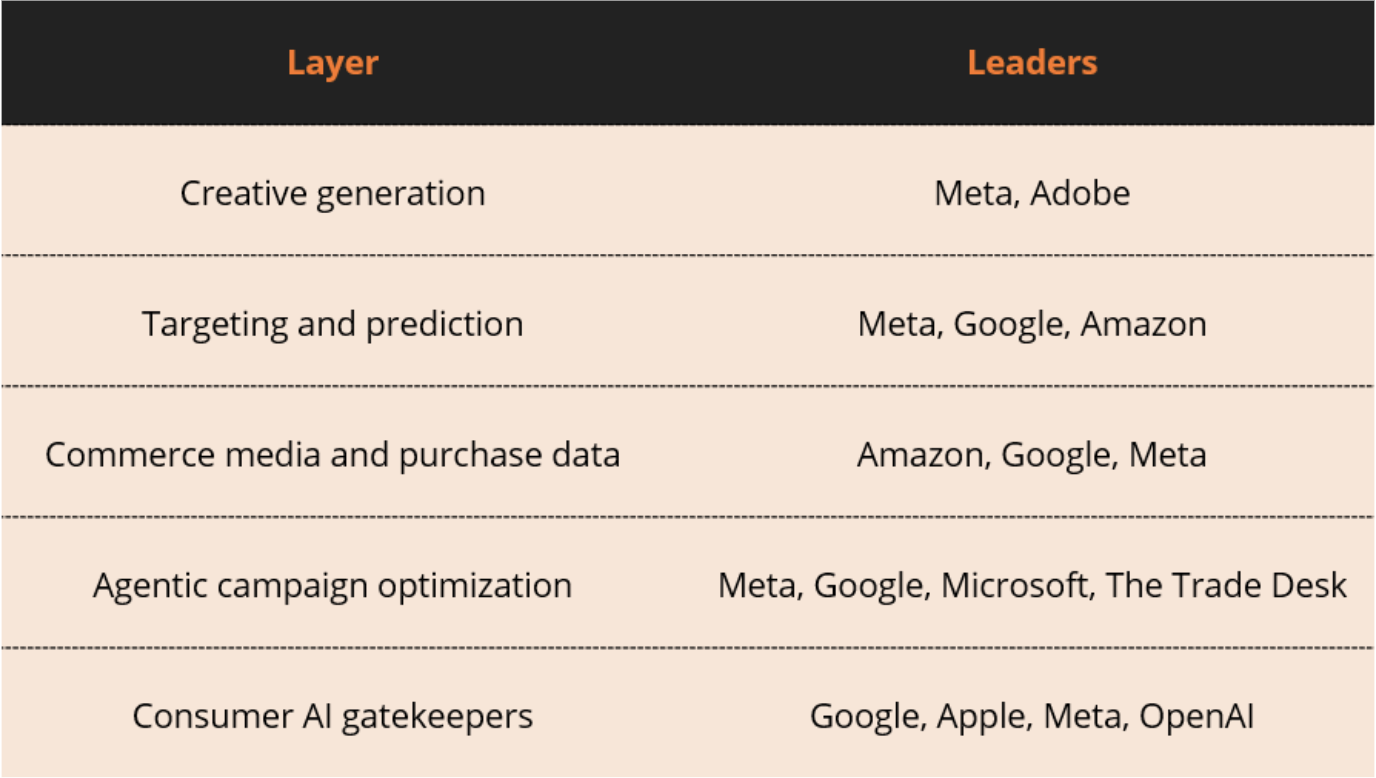
AI is reshaping advertising across five layers. Q1 earnings show where each platform is placing bets, and where money is actually moving.
Meta: AI is already driving ad revenue
Q1 ad revenue: $56.3B (+33%)
Ad revenue: $55.02 billion (+33%)Impressions +19%, price per ad +12%
What’s driving growthMeta directly attributes gains to AI improvements. Lattice and GEM increased conversion rates by 6%+ for landing-page-view ads. Adaptive ranking added another 1.6% lift.
More than 8 million advertisers now use Meta’s generative AI tools. Video generation users are seeing 3%+ higher conversion rates in tests.
What’s newMeta Ads AI Connectors, which lets advertisers connect their Meta accounts directly to external AI agents. Agencies and brands can now analyze and optimize campaigns using their own AI workflows. That's a direct step toward agentic media buying
TakeawayMeta is currently the clearest proof that AI investment translates into measurable ad performance. What analysts are saying: Wedbush's Dan Ives argued the ad revenue strength can "silence capex bears" because Meta's AI spending ($125-145 billion in 2026 capex) is showing up in advertising results.
Google: strongest position, highest exposure
Q1 revenue: $109.9B (+22%)Ad revenue: $77.25 billion (+15%)
Search: $60.4B (+19%)Youtube : $988 B (+11%)
Network: $6.97B (-4%)
What’s driving growth
AI Overviews and AI Mode are increasing search usage. Overviews now reach 2B+ monthly users. AI-powered bidding drives 78% of ad spend.
The tensionAI Overviews appear in ~48% of searches. Google says monetization per query is stable, but engagement data shows paid CTRs dropped 68% on these queries.
Google is compensating by inserting more ads into AI results (from 3% to 25.5% of pages), but the shift from clicks to answers is real. Ads in the standalone Gemini app are a possibility, not a plan. CBO Philipp Schindler said on the earnings call they're focused on AI Mode first and "open to" Gemini after, but no timeline or format has been announced.
The bigger playGoogle referenced Universal Commerce Protocol and agentic commerce during the earnings call, with partners including Amazon, Meta, Microsoft, Salesforce, and Stripe. That signals Google is trying to shape the transaction layer for AI agents, not just the ad layer.
TakeawayAI is strengthening Google overall, but long-term monetization depends on preserving high-intent behavior in an answer-driven interface.
Five Layers of AI Advertising Disruption
Every major platform reported this quarter. Here’s what each is actually doing.
Amazon: the commerce data advantage
Total revenue: $181.5B (+19%)
Q1 ad revenue: $17.2B (+24%)Operating margin: 13.1% (record)
What’s driving growthAmazon Ads is evolving into a full-funnel system across retail, streaming, and TV. AI agents like Rufus are capturing high-intent shopping moments.
Why it mattersAmazon’s edge is closed-loop data: browsing, purchasing, returns, subscriptions, and lifetime value.
As optimization shifts from clicks to outcomes, this dataset becomes the most valuable targeting asset in the market.
TakeawayRetail media is becoming the core performance layer of advertising, and Amazon is leading it.
Microsoft: ads + enterprise workflow
Q1 revenue: $82.9B (+18%)Ad revenue: search and news advertising grew 16%, LinkedIn revenue $4.71 billion (+10%) with Marketing Solutions up 12%. Microsoft does not break out total ad revenue as a single line item, but advertising is estimated at $19.5 billion annually.
Ad businessMicrosoft runs a larger advertising operation than most people realize. Bing hit 1 billion monthly active users. LinkedIn paid video ads grew 30% YoY. As Copilot gets embedded into search, Microsoft is quietly building an AI-native ad surface that reaches a professional and enterprise audience Google and Meta don't own
Enterprise layerCopilot, Azure AI, Dynamics, and LinkedIn are becoming the operating system for B2B marketing, covering planning, segmentation, content, CRM, and analytics.
TakeawayWhat analysts are saying: for marketing, Microsoft has two plays: a growing ad platform (Bing + LinkedIn) for reaching professionals, and an enterprise infrastructure layer for how marketing teams actually run. Neither competes head-on with Meta or Google for consumer attention, but both are gaining share in B2B.
Adobe: from creative tool to marketing infrastructure
Q1 revenue: $6.4B (+12%)Marketing-relevant revenue: Digital Experience segment $1.52 billion (+9%), which includes Adobe Experience Platform, GenStudio, and Marketing Agent. Creative tools revenue (Firefly, Creative Cloud) drives the rest. Adobe does not sell advertising. It sells the tools marketers use to create, manage, and optimize.
What’s happeningGenStudio ARR grew 30%+ YoY. Firefly ARR exceeded $250 million with subscription ARR up 75% QoQ. Generative credit consumption increased 45% QoQ, with video generation up 8x YoY.
New development Adobe and Canva both launched deep integrations with Claude, bringing design workflows directly into AI workspaces.
TakeawayAdobe is no longer competing just on the creative tool. It's embedding its marketing intelligence and creative production into the AI surfaces where work actually happens. The risk is that it becomes a connector inside someone else's platform rather than the platform itself
The Trade Desk: defending the open internet
2025 revenue: $2.9B (+18%)Q1 guidance: ~$678M (+10%)
What’s happeningKokai, its AI platform, is now used by nearly all clients, modularizing ad buying and optimizing each component independently.
ChallengeA dispute with Publicis raises concerns about transparency, critical for independent adtech positioning. It breaks ad buying into individual components (identity, fraud detection, creative, bidding) and applies AI to each one separately rather than as a single black box. The Trade Desk is positioning itself as the independent alternative to walled-garden buying on Google, Meta, and Amazon.
TakeawayWhat analysts are saying: the core question is whether AI-powered optimization on the open internet can hold share against walled gardens that own the data, the inventory, and increasingly the AI creative tools. TTD's 10% Q1 guidance was below expectations, which is why the stock dropped despite full-year beats.
What this means for agencies
39% of CMOs plan to cut agency budgets
22% say AI has already reduced reliance on agencies
AI is absorbing creative production, media buying, and optimization.
Omnicom’s agent-based buying signals what’s next: automation at the execution layer, pressure on the service layer
TakeawayAgencies must shift from labor to AI-augmented strategy and transformation.
Sources
Meta Q1 2026 earningshttps://investor.atmeta.com/investor-news/press-release-details/2026/Meta-Reports-First-Quarter-2026-Results/default.aspx
Alphabet Q1 2026 earnings (SEC filing)https://www.sec.gov/Archives/edgar/data/1652044/000165204426000043/googexhibit991q12026.htm
Amazon Q1 2026 earnings (CNBC)https://www.cnbc.com/2026/04/29/amazon-amzn-q1-earnings-report-2026.html
Adobe Q1 FY2026 earnings (Futurum Group)https://futurumgroup.com/insights/adobe-q1-fy-2026-earnings-show-ai-monetization-progress-amid-ceo-transition/
Adobe–Anthropic connector announcementhttps://blog.adobe.com/en/publish/2026/04/28/adobe-for-creativity-connector
Gartner 2025 CMO Spend Surveyhttps://www.gartner.com/en/newsroom/press-releases/2025-05-12-gartner-2025-cmo-spend-survey-reveals-marketing-budgets-have-flatlined-at-seven-percent-of-overall-company-revenue
The Trade Desk FY2025 earningshttps://investors.thetradedesk.com/news-and-events/news/news-details/2026/The-Trade-Desk-Reports-Fourth-Quarter-and-Fiscal-Year-2025-Financial-Results/
