
95% of marketing AI still needs a human to click “approve”
This week, I’m speaking at POSSIBLE in Miami about a new MMA study on how enterprise marketers are deploying agentic AI.
The preview: 95% of marketing AI still operates behind human approval gates. Only 5% acts autonomously.
Adoption is wide—but only an inch deep.
The full report lands in May, but the early data already tells a clear story about where the gap is: enterprise organizations aren’t ready for agentic AI, and agentic AI isn’t fully ready for enterprise environments. Yet one factor stands out above all others: having a hands-on leader driving adoption is the strongest predictor of deployment.
In the second piece, we map where the AI model race actually stands now that raw reasoning has become a commodity. Google, OpenAI, Anthropic, and Perplexity are all building toward the same destination: a single surface where everything happens.
The question for marketers is which model controls your customer’s discovery—and it may not be the one you use for your own work.
Let’s get into it.
— Vas
This Week’s Signals
AI & Big Picture
Headcount out, compute in
Meta is cutting 8,000 jobs and canceling 6,000 open roles. Microsoft offered buyouts to 8,750 workers. Both companies posted record revenues. Both are doubling down on AI infrastructure spending. Meta’s 2026 capex: $115–135 billion, nearly double last year. (Read more)
Your keystrokes are training data now
Meta will install tracking software on employee laptops to capture clicks, keystrokes, and screen interactions. The data feeds its Model Capability Initiative, turning daily work into training data for AI agents. (Read more)
Anthropic is approaching $1 trillion
Private secondary shares are reportedly trading near a $1 trillion valuation. For context, only seven companies have crossed that mark: Apple, Microsoft, Nvidia, Amazon, Alphabet, Meta, and Tesla. (Read more)
Everyone is building the super app
OpenAI introduced GPT-5.5, merging its model with Codex and Atlas into a single execution surface for research, coding, and planning. Google, Anthropic, and Perplexity are converging on the same idea. (Read more)
AI & Marketing
ChatGPT ads move to cost-per-click
Ten weeks after launching CPM ads at $60, OpenAI shifted to CPC pricing at $3–5 per click with a self-serve ads manager. Early advertisers include Target, Ford, Adobe, and Expedia. OpenAI projects $2.5 billion in ad revenue for 2026. (Read more)
The new B2B battleground is the AI shortlist
71% of B2B buyers now rely on AI chatbots during research. 54% say AI is the top influence on their vendor shortlist, ahead of review sites (43%) and vendor websites (36%). 69% said AI surfaced information that led them to choose a different vendor. (Read more)
BIG PICTURE
The Readiness Gap Runs Both Ways
Today I’m speaking at POSSIBLE about a new MMA study on how enterprise marketers are deploying agentic AI. The full report lands in May. This is the preview.We asked enterprise marketers where their organizations stand.
The headline: AI is everywhere in the workflow—and trusted to act almost nowhere.
95% of marketing AI still runs human-gated, with a person clicking approve before anything ships.
Only 5% acts autonomously, even within guardrails.
52% of marketers are still in exploration.
35% are deploying into real workflows.
12% are scaling.
Adoption is wide—and only an inch deep.
Asked what is most likely to limit their ability to scale, marketers ranked people and process first (72%), followed by data (55%), governance and risk (41%), technology (39%), and leadership/strategy (32%).
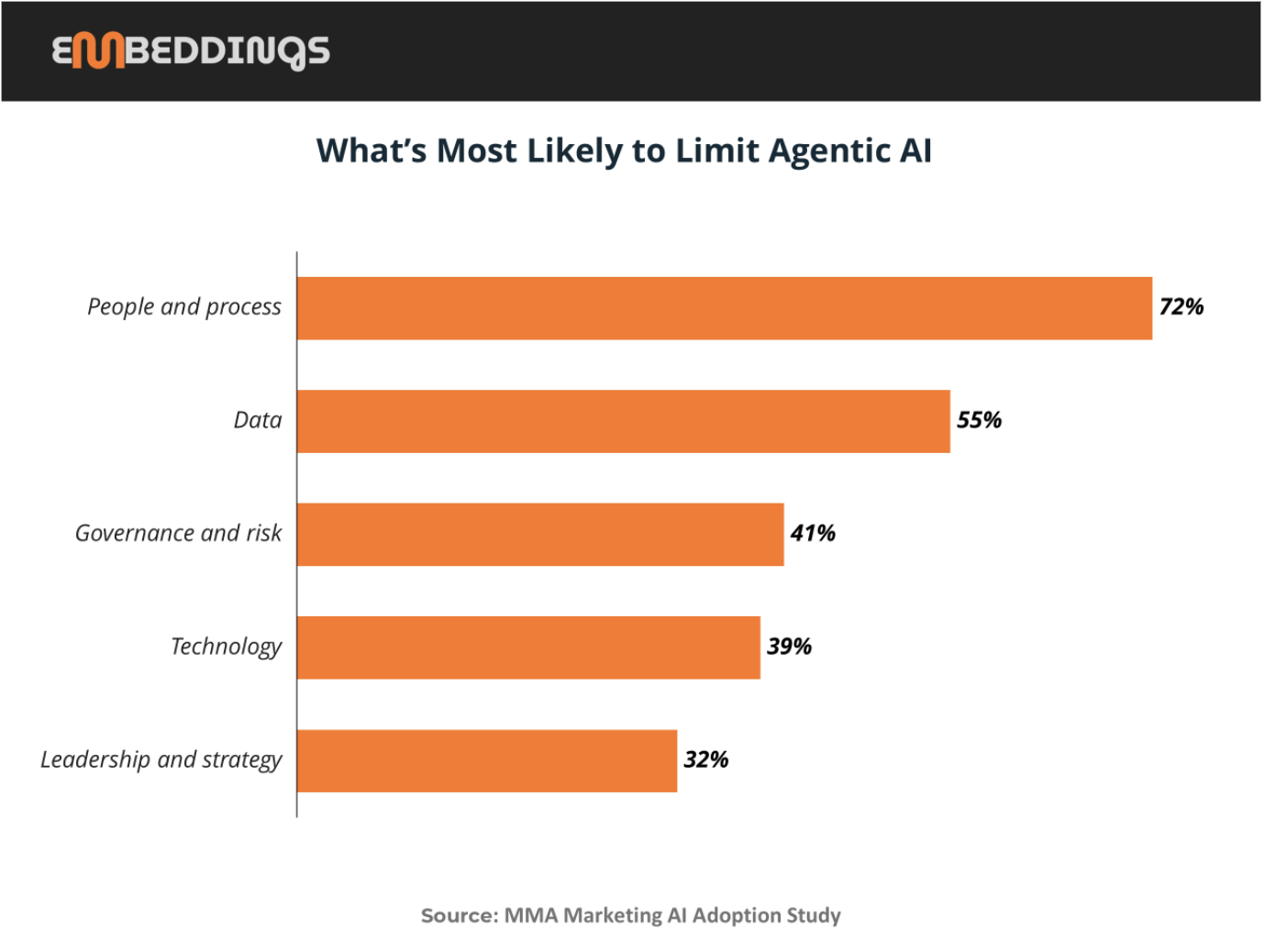
The thesis: technology is not the primary problem—but it is not problem-free either.
39% of marketers still cite reliability, consistency, and regulatory fit as real obstacles.
Both sides of the gap are still maturing, and the technology’s unreliability compounds enterprise friction. The enterprise side simply has more work to do.
A few weeks ago, we wrote about the skill tax inside AI teams.
This is the org-chart version of the same finding: experience and infrastructure compound over time—and they are hard to buy.
The full report goes deeper into the 31% of marketers with hands-on AI experience.
They see what is already in place more clearly than the rest, and they’ve built more of the missing pieces.
They decide based on evidence rather than permission, and they measure business KPIs rather than hours saved.
If you’re asking how to close your side of the gap faster, that’s where the answer lives.
Publishing in May.
The Model Race Was 2025. The Platform Race Is 2026.
By April 2026, the AI industry has reached a post-benchmark state.
Top-tier models from Google, OpenAI, and Anthropic are clustered within a 25 Elo-point margin.
General benchmarks like MMLU are saturated.
Raw reasoning is now a commodity.
Competition has shifted from who thinks best to who controls the surface where work and discovery happen.
Every major player is building toward the same destination: a unified execution surface where research, coding, and planning converge.
OpenAI calls it Hermes. Anthropic has Claude Code and Cowork. Google has Deep Research Max with a million-token context window. Perplexity is building Computer, an autonomous agent for end-to-end production.
2026 AI Competitive Matrix
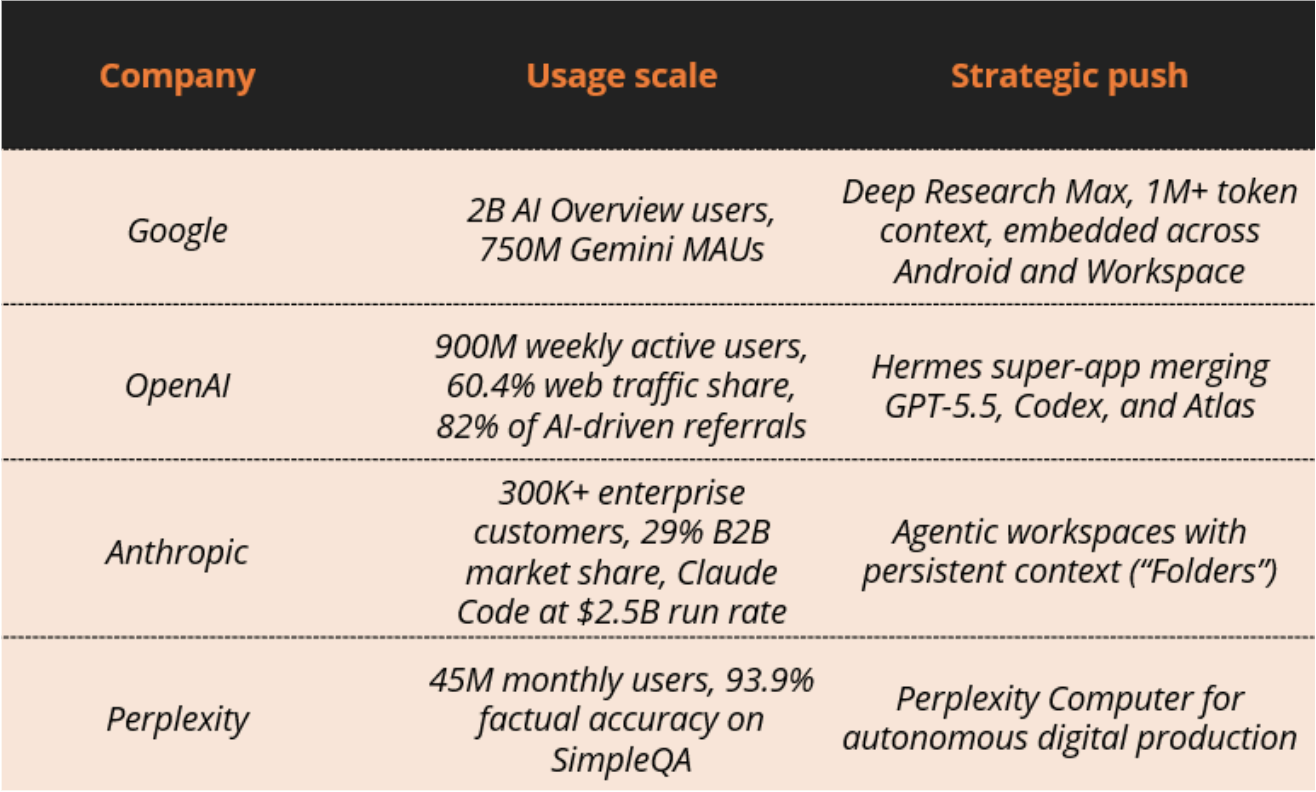
For marketers, two things follow from this convergence.
First, the model you use for work is increasingly different from the model that controls customer discovery. Claude may be how your team builds campaigns. Google AI Overviews may be where your customer never clicks a link.
Both matter—and each requires a different strategy.
Second, traditional search is losing its grip on discovery. 61% of Gen Z prefers AI tools over search. 90–95% of AI citations reference third-party reviews and community signals rather than a brand’s own website.
The G2 study this week found that 54% of B2B buyers say AI chatbots are the top influence on their vendor shortlist, ahead of review sites and vendor websites.
Success is no longer measured by visits to your domain. It is measured by your share of voice inside the models your customers use to decide.
