
Meta is on track to overtake Google in global ad revenue this year: $243.5 billion to $239.5 billion, according to eMarketer. The ad crown is changing hands for the first time. It took Meta twenty years to get here. OpenAI is trying to do it on a different timeline.
ChatGPT ads launched ten weeks ago at a $60 CPM. They're already down to $25. A self-serve ads manager and a conversion pixel shipped in the same window. The infrastructure is moving fast. The proof is not there yet.
This week, we break down where ChatGPT ads actually stand, what's working, what's missing, and why the intent question matters more than price. In the second piece, we look at the Stanford AI Index 2026 and why junior marketing roles are disappearing while productivity climbs.
Let's get into it.
— Vas
This Week's Signals
Marketing
The ad revenue crown is changing hands: eMarketer projects Meta at $243.5 billion in global ad revenue in 2026 versus Google's $239.5 billion, fueled by Reels ($50B run rate) and Advantage+ ($60B run rate). (Read more)
Block the ad, not the advertiser: Google blocked 8.3 billion ads in 2025, 63% more than the year before, but suspended 36% fewer advertiser accounts. AI is shifting enforcement from account bans to ad-level removal. (Read more)
Order coffee by describing your mood: Starbucks launched a beta app inside ChatGPT. Describe how you feel, upload a photo, get a personalized drink, customize it, and start checkout without leaving the conversation. (Read more)
Design without opening a design tool: Canva's new partnership with Anthropic lets users generate branded, editable visuals directly inside Claude conversations. (Read more)
AI & Big Picture
€80 billion to close the gap: Europe is channeling record public money into venture capital through the EU, Germany, and France, but still produces 80% fewer scaleups and 85% fewer unicorns than the U.S. (Read more)
Cloning the CEO: Meta is building an AI version of Mark Zuckerberg so employees can “talk to the boss” without actually talking to the boss. (Read more)
BIG PICTURE
10 Weeks In: Where ChatGPT Ads Actually Stand
ChatGPT ads launched on February 9. Ten weeks later, the early picture is coming into focus.
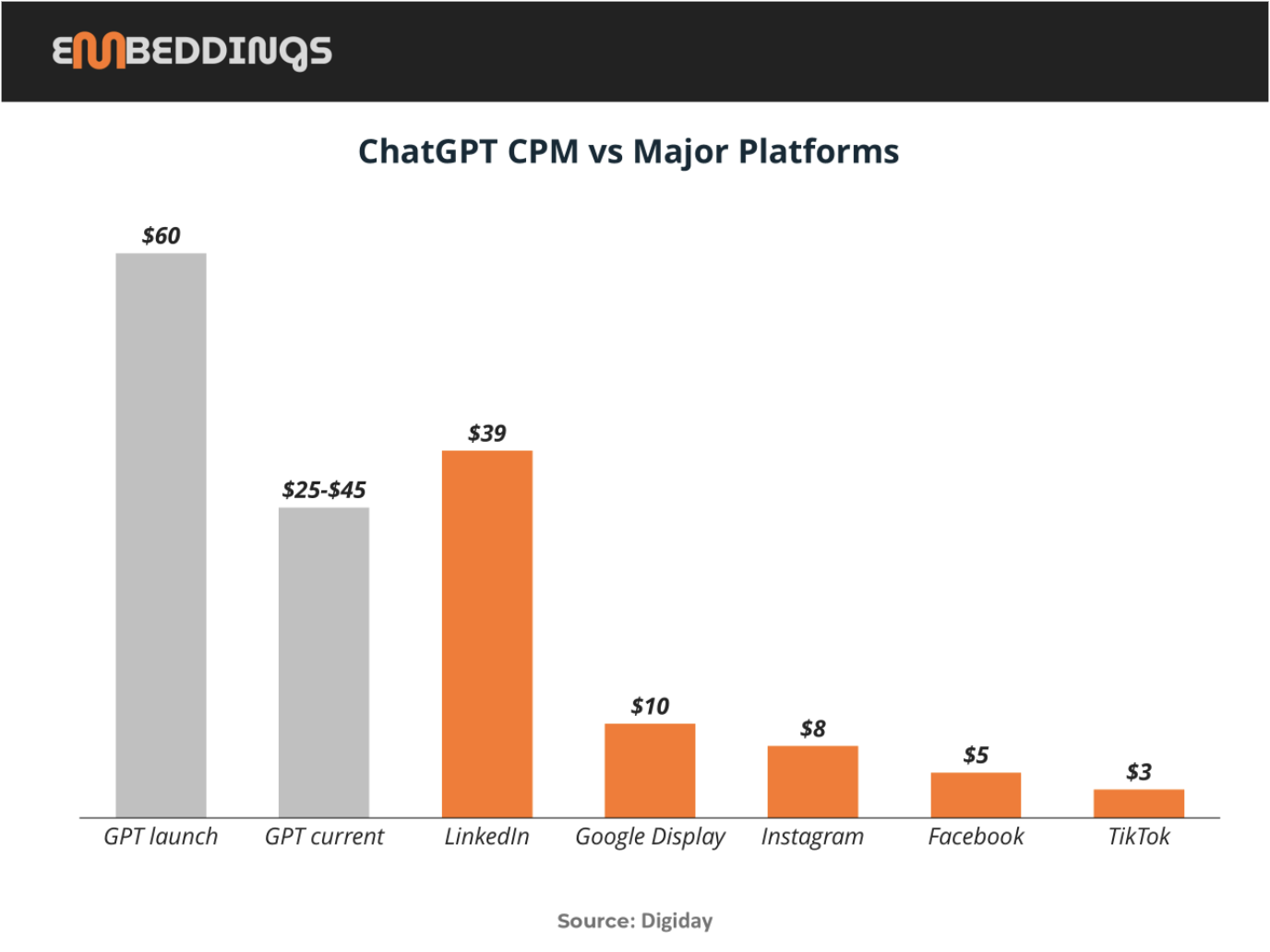
Cost is dropping. Launch CPMs were $60 with a $250,000 minimum spend. Nine weeks in, advertisers buying through Criteo report CPMs between $25 and $45, with some as low as $15, according to Ad Age. The minimum spend is down to $50,000.
For comparison: LinkedIn averages $39 CPM, Google Display about $10, Facebook under $5. ChatGPT started at a premium and is settling toward the upper end of the market.
The tooling is catching up. OpenAI shipped a self-serve ads manager and a conversion tracking pixel in the first ten weeks. The ads manager supports CPM buying and keyword targeting, with CPC and CPA listed as “coming soon.”
The pixel tracks post-click actions like registrations and orders but is only available to select advertisers. Both are functional, but neither is close to what Google or Meta offer after two decades of iteration.
OpenAI claims $100 million in annualized ad revenue after six weeks, but agency executives say they have not seen measurable business outcomes yet. Click-through rates are running as low as 0.91%, compared with Google Search's 6.4% benchmark.
The intent question is open. On Google, someone searching “best running shoes” is sending a clear commercial signal. On ChatGPT, someone might ask about running in a conversation that covers training plans, injury recovery, and shoe recommendations in the same thread.
The commercial intent is there, but it lives inside a longer, more varied interaction.
Someone comparing SUVs or planning a trip carries real purchase intent. Someone debugging code or summarizing a spreadsheet does not. The same ad can appear across both types of conversation, and writing creative that works across that range is harder than writing for a keyword cluster.
Nobody, including OpenAI, has a settled answer on which type of usage dominates. That is not a weakness of the format. It is a question the pilot is designed to answer.
Where the budget is coming from. Current spend is test and innovation budget, not core allocations. As one agency lead put it, budget is “shifting from the top of the funnel to fund what's being positioned as a new direct response channel.”
The conversion pixel is what makes that shift possible, but independent measurement is still missing. Google and Meta earned that credibility over twenty years through third-party attribution, incrementality testing, and media mix models. OpenAI is asking advertisers to trust its own reporting for now.
OpenAI projects advertising at 36% of its revenue by 2030, roughly $102 billion. To reach that, it would need to grow its ad business about 20x faster than Netflix did in its first three years.
Ten weeks in, the infrastructure is moving. The proof will take longer.
The Ladder Is Changing Shape

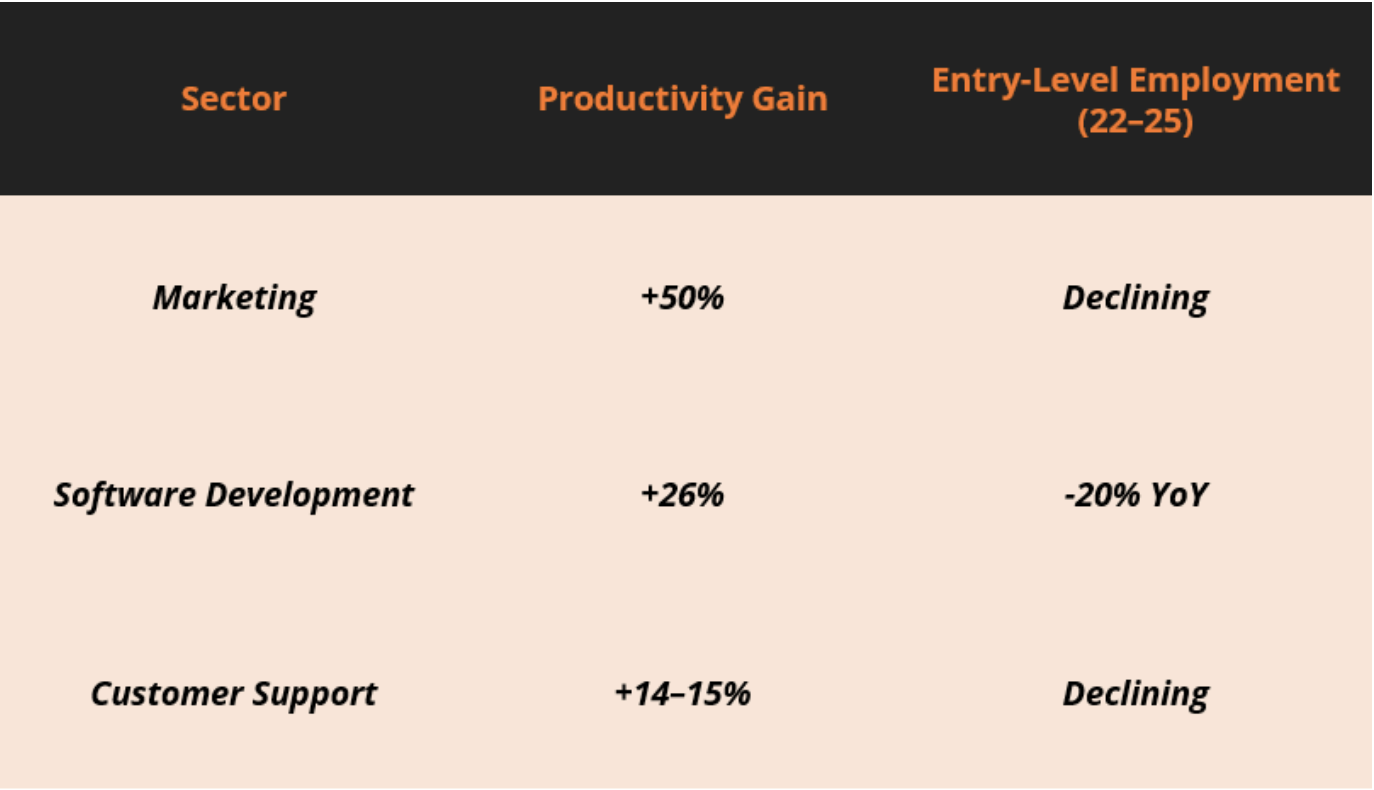
The Stanford AI Index 2026 tracked employment across AI-exposed occupations by age. Workers aged 22–25 saw employment fall nearly 20%. Workers over 35 held steady or grew. The impact is not uniform. It is concentrated at the bottom.
At the same time, productivity in those same fields is rising. The report found gains of:
26% in software development
14–15% in customer support
50% in marketing output
Organizations are getting more from fewer people, and 88% have adopted AI in some form. One-third expect workforce reductions in the coming year.
The gains come with a caveat the report flags directly: they show up in structured, measurable work where outputs are easy to monitor. In roles requiring deeper reasoning or judgment, gains shrink or disappear.
The gains come with a caveat the report flags directly: they show up in structured, measurable work where outputs are easy to monitor. In roles requiring deeper reasoning or judgment, gains shrink or disappear. There is also an emerging concern that heavy AI reliance may carry long-term learning penalties that slow skill development over time.
That matters for marketing more than any other function. The tasks AI handles fastest are the same ones that used to train junior marketers: first-draft copy, campaign reports, media plans, landing pages. BCG found 90% of marketing manager tasks are exposed to disruption. Output is up. But the managers of tomorrow are the trainees of today. If those training roles stop existing, the productivity gains you're seeing now come at the cost of the leadership bench you'll need in three to five years.
Marketing Embeddings is read by 20,000+ CMOs, CTOs, and media leaders navigating AI's impact on marketing. Forward this to someone who needs to see it.
