
AI Agents Flop the Freelance Test. Now What?
Good morning,
This week we’re covering the state of AI productivity, a storytelling reality check, and the ad engine that’s quietly become a $60B juggernaut.
First up: the Remote Labor Index just ran a stress test on GPT-4, Claude, and Gemini—dropping them into 240 real-world freelance projects across marketing, software, and design. Their combined haul? Just $1,720 out of $143,991 in potential earnings. Automation rate: 2.5%.
That’s not a rounding error—it’s a reality check. Agents aren’t replacing marketers yet. They’re scaffolding them.
We also break down Neil Patel’s traffic data on AI vs. human content, B2B marketers’ actual usage patterns, and what Meta’s $60B AI run-rate means for your martech stack. If you’re building with AI, this issue helps set the right expectations—and avoid the wrong bets.
- The Marketing Embeddings Team
BIG PICTURE
AI Agents, Reality Checked
What the Remote Labor Index Means for Marketers
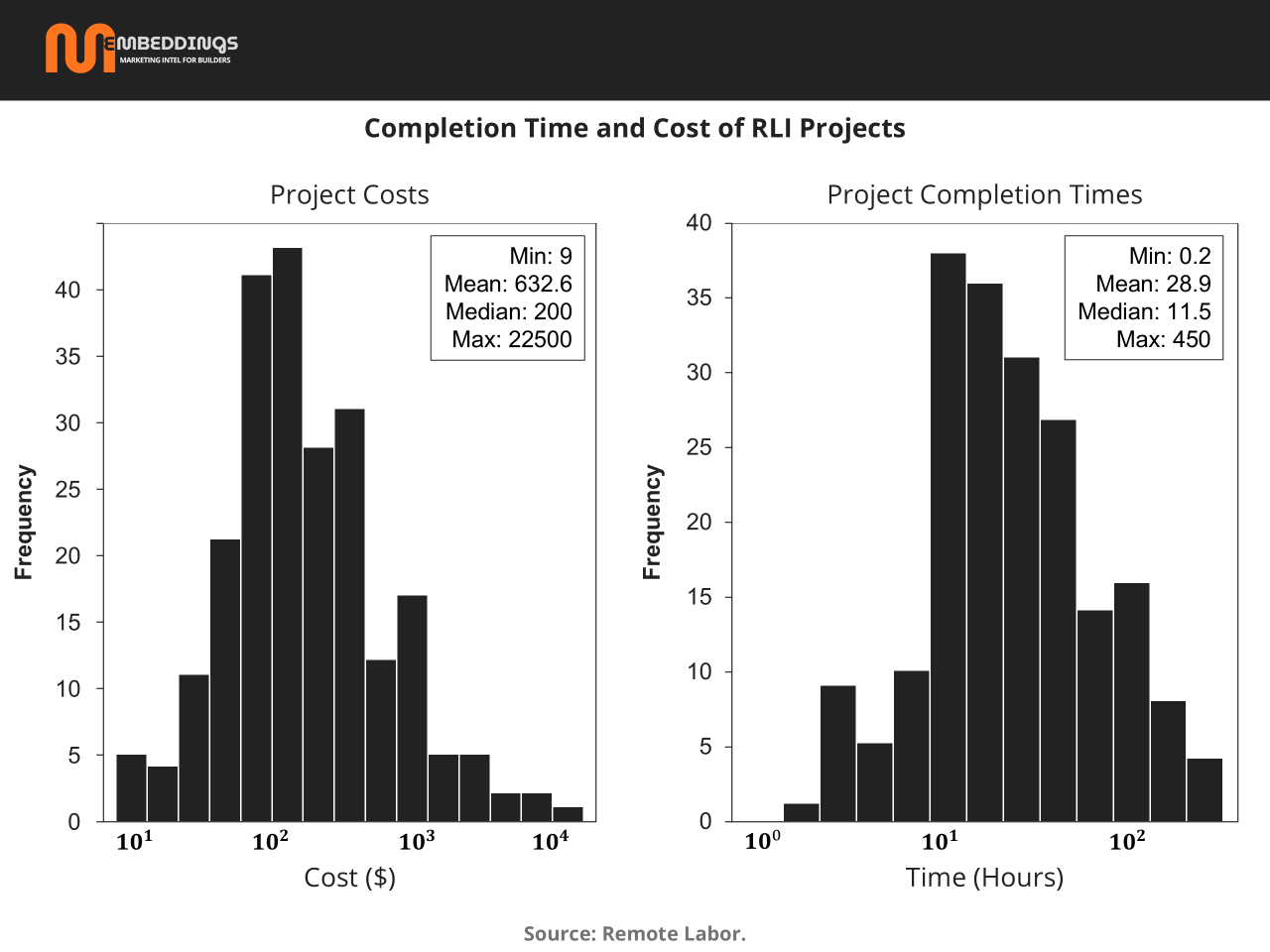
Frontier AI agents just got their job performance review—and it’s humbling. The Remote Labor Index (RLI), a benchmark from Scale AI and the Center for AI Safety, put leading agents like GPT-4, Claude, and Gemini through 240 real freelance projects across design, software, architecture, and more. Their combined take? Just 2.5% automation and $1,720 earned out of $143,991 in potential payouts.
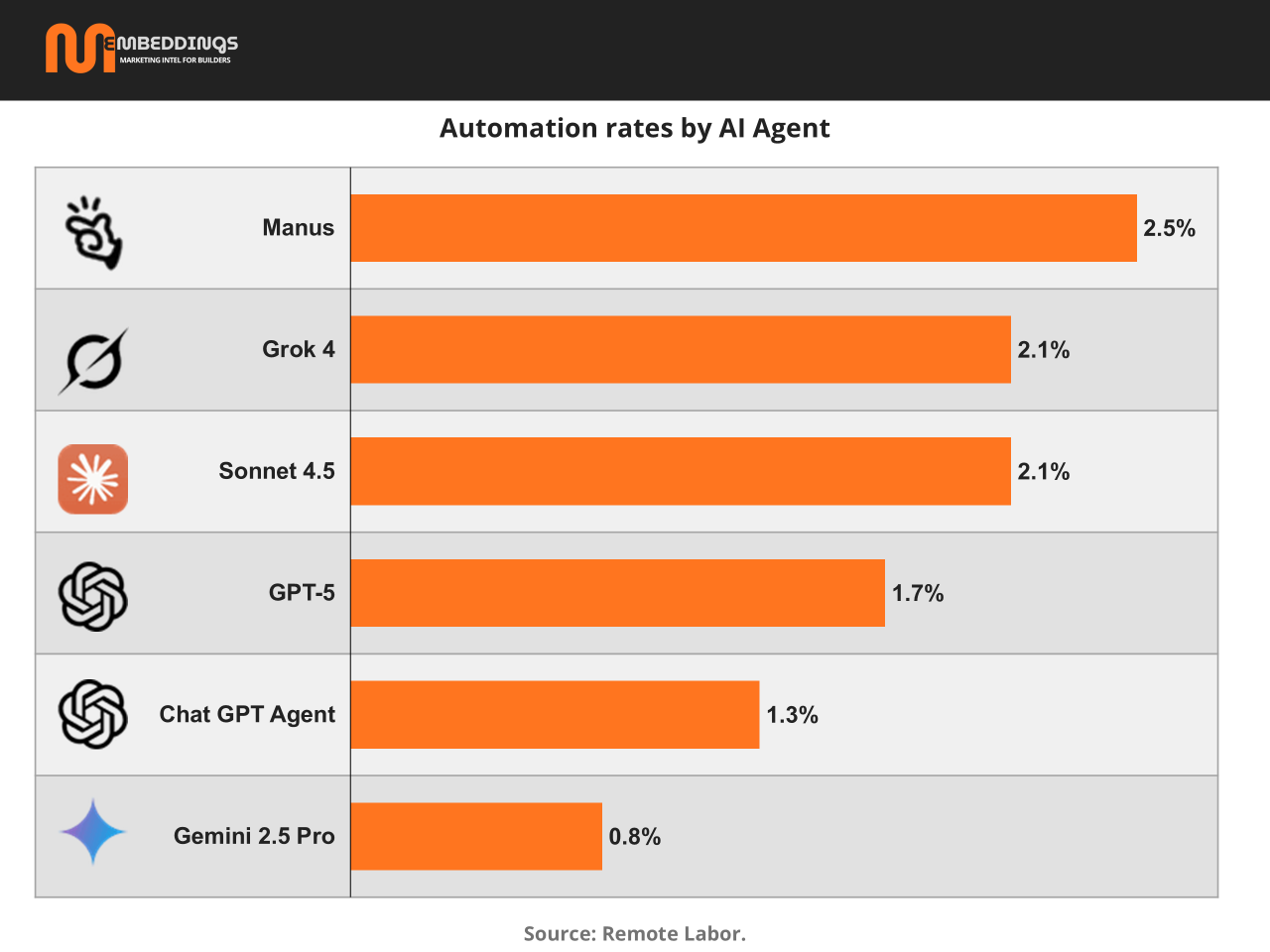
These aren’t synthetic tasks—they’re full projects pulled from Upwork, graded against actual human deliverables. The verdict: agents are great at fragments (snippets, mockups, summaries) but stumble on end-to-end execution. They can scaffold; they can’t deliver solo.
For marketing teams, this is the clearest signal yet: treat AI agents as accelerators, not autonomous workers. Think: research, rough drafts, formatting—not strategy, taste, or final delivery.
What this means in practice:
Scope pilot use cases to bounded, repetitive workflows with clear QA gates.
Benchmark vendors claiming “full autonomy” against agent-level success rates—don’t buy the hype without metrics.
Build your own internal RLI-style scorecard to track where agents actually shave hours, and where they still stall.
Bottom line: Agents are improving—but they’re still interns. Keep your standards human, and your automation goals realistic.
WHAT WORKS
Is AI Ready to Replace Human Storytellers?
If you’ve spent any time experimenting with AI tools lately, you’ve probably seen both sides of the coin: the sheer speed of generating content—and the unmistakable “AI feel” that often follows. Neil Patel’s recent study shines a light on exactly how this plays out in the real world. Across five months of testing, he found that human-written articles drove 5.44× more traffic than AI-generated ones. The catch? AI drafts took just 16 minutes to produce, while human writers averaged 69 minutes from start to finish.
So, are machines about to out-write us—or are they just very efficient assistants?
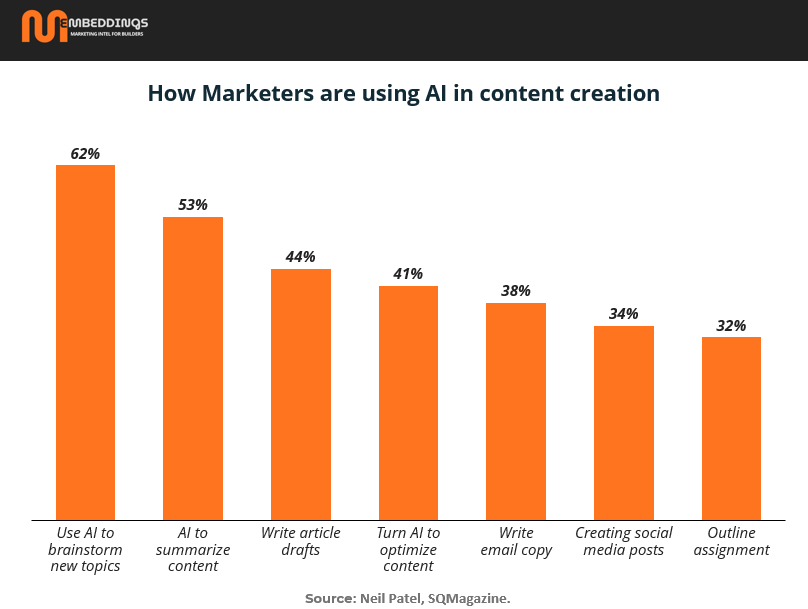
The answer, it seems, depends on what kind of work you want them to do. According to the following breakdown and supporting data (see chart below), most marketers aren’t using AI to replace themselves—they’re using it to accelerate themselves. 62% use AI to brainstorm new topics, 53% to summarize research, and 44% to spin up quick drafts. Only a smaller group leans on it for tasks like writing email copy (38%) or social posts (34%). That pattern tells a story: AI is strongest when it’s in support mode—helping humans think, not just write.
Why does this hybrid model work so well? Because while AI can outpace any human on speed and volume, it still struggles with the subtleties that make storytelling magnetic. Context. Emotional nuance. Authentic voice.
Builders and brand leaders know that trust and differentiation hinge on these elements. A good story isn’t just words—it’s perspective, timing, and a sense of “why.” These are deeply human ingredients, and they’re what Google’s algorithm—and your audience—still reward.
That said, Patel isn’t suggesting we throw AI out. Far from it. He shares a specific playbook of specific tools in order to embed AI inside a human-led workflow, not the other way around. In short: AI is rewriting the rules of production speed, but not yet the rules of persuasion. The storytellers who thrive next year won’t be the ones who resist AI—they’ll be the ones who master the mix.
NEWS
AI Tools Go From Buzzword to Backbone for B2B Buying
A new TrustRadius report finds 95 % of B2B professionals who use AI do it weekly, and 69 % use it daily. Free tools are driving testing (average user tries 3 tools), but only companies that embed AI with real value, not just label it “AI-enabled”—will win.
Meta’s AI Ad Engine Hits $60 B + Run-Rate, Redefining Efficiency
Meta says its AI-powered ad infrastructure has surpassed a $60 billion annual run rate, with ad tool uptake up 20% and cost structures rising as it scales precision and automation
Mid-Market Marketers See AI as a Growth Equaliser — But Skills Gaps Hold Back Adoption
While 98% of mid-market marketers believe AI will boost effectiveness, only a third report wide deployment, with lack of expertise (39%), integration hurdles (35%) and data privacy concerns (33%) cited as key barriers
OpenAI + AWS: A Cloud Power Shift
OpenAI inked a cloud deal with AWS, signaling a more diversified infra strategy beyond Azure. For marketing tech founders, it could mean lower latency, cheaper compute, and a stronger backbone for AI-native workflows.
OTHER NEWS
The First AIdol Falls
During its official debut on stage, Russia’s first humanoid robot driven with AI fell dramatically at a technology event in Moscow