
Who owns the chain when every player wants all of it
The boundaries between marketer, agency, platform, publisher, retailer, and AI company are dissolving. Every player is expanding into work that used to belong to someone else. This week, six moves that show what integration actually looks like.
Most weeks, the AI marketing news reads like a list of features and deals. Step back from it and a different picture shows up: the role structure that marketing has operated under for fifty years is being rewritten in real time. Specialized roles are collapsing into integrated stacks. Some pieces of the chain are being commoditized. Others are becoming more valuable.
This week gave us six moves that fit the pattern. Below them, the essay underneath asks which pieces of the chain still matter, and where trust ends up when one player controls most of them.
This week gave us a lot to think about. The picture will keep moving.
— Vas
This Week's Signals
Kantar BrandZ 2026: AI companies enter the brand hall of fame. Google knocked Apple out of the top spot with 57% brand value growth to $1.48 trillion. ChatGPT debuted at number 15. Claude debuted at number 27. Nvidia is now at 5. The BrandZ methodology, validated by the Marketing Accountability Standards Board, multiplies financial value by a Brand Contribution score drawn from millions of consumer interviews measuring whether a brand is meaningful, different, and salient. Surviving that screen means consumers have a brand relationship with you. ChatGPT and Claude have one. (Adweek)
Publicis acquires LiveRamp for $2.2 billion. All-cash deal at $38.50 per share, 29.8% premium. Continues the thesis Publicis started with Epsilon in 2019: stop competing on labor, own data infrastructure. LiveRamp resolves identity across walled gardens, clean rooms, publishers, and retail media networks. This is the largest commitment yet to the bet that brands want a neutral data layer that works across the walled gardens, not one owned by them. (Adweek)
The Economist builds a two-track internet. Publisher producing agent-readable versions of marketing pages and content already outside the paywall, while keeping the human site for subscribers. The VP of generative AI calls agent optimization "a defensive baseline." Same content, different products. Publishers are no longer in a single distribution business. (Digiday)
TikTok opens MCP server for third-party AI agents. Announced at TikTok World. Third-party agents can now build and manage TikTok campaigns autonomously through Model Context Protocol. This joins Meta's AI Connectors and Amazon's Ads Agent (covered in previous issues). Walled gardens are becoming infrastructure for whoever's agent ends up doing the buying. (Adweek)
Netflix brings autonomous AI agents to its $3 billion ad business. Suite of AI tools at upfront: agents that build media plans, agents that manage and purchase ads autonomously on the platform, creative adaptation tools. Programmatic capabilities expanding to pause ads, live content, Amazon DSP, and Yahoo DSP. (Adweek)
Amazon replaces Rufus with Alexa for Shopping. Agentic AI assistant moves into the search bar of Amazon's main app, on top of Amazon DSP, on top of the largest retail media network, on top of the largest closed-loop commerce dataset. Amazon now operates at every layer of marketing simultaneously. (Adweek)
The Big Picture: Marketing's role structure is being rewritten

For most of the last fifty years, marketing worked through specialization. Marketers paid. Agencies created campaigns and bought media. Publishers and platforms ran ads. Adtech wired the pieces together. Each player had a defined job and stayed in it.
That structure has been dissolving for a while now. What makes the moment worth pausing on is the pace. Moves that would have been unthinkable a few years ago (a holdco paying billions for an identity layer, a platform handing campaign management to third-party AI agents, a retailer putting an agentic AI in its search bar) now arrive almost weekly. The remarkable is becoming routine.
Every player in the marketing chain is expanding into roles that used to belong to someone else. Agencies are buying data infrastructure. Platforms are absorbing creative and media work. Retailers, after spending the last few years building ad networks, are now also becoming AI shopping interfaces. AI companies are becoming consumer brands and selling ads. Publishers are building separate products for human readers and for AI agents.
The story isn't only about who controls more pieces. It's about which pieces still matter.
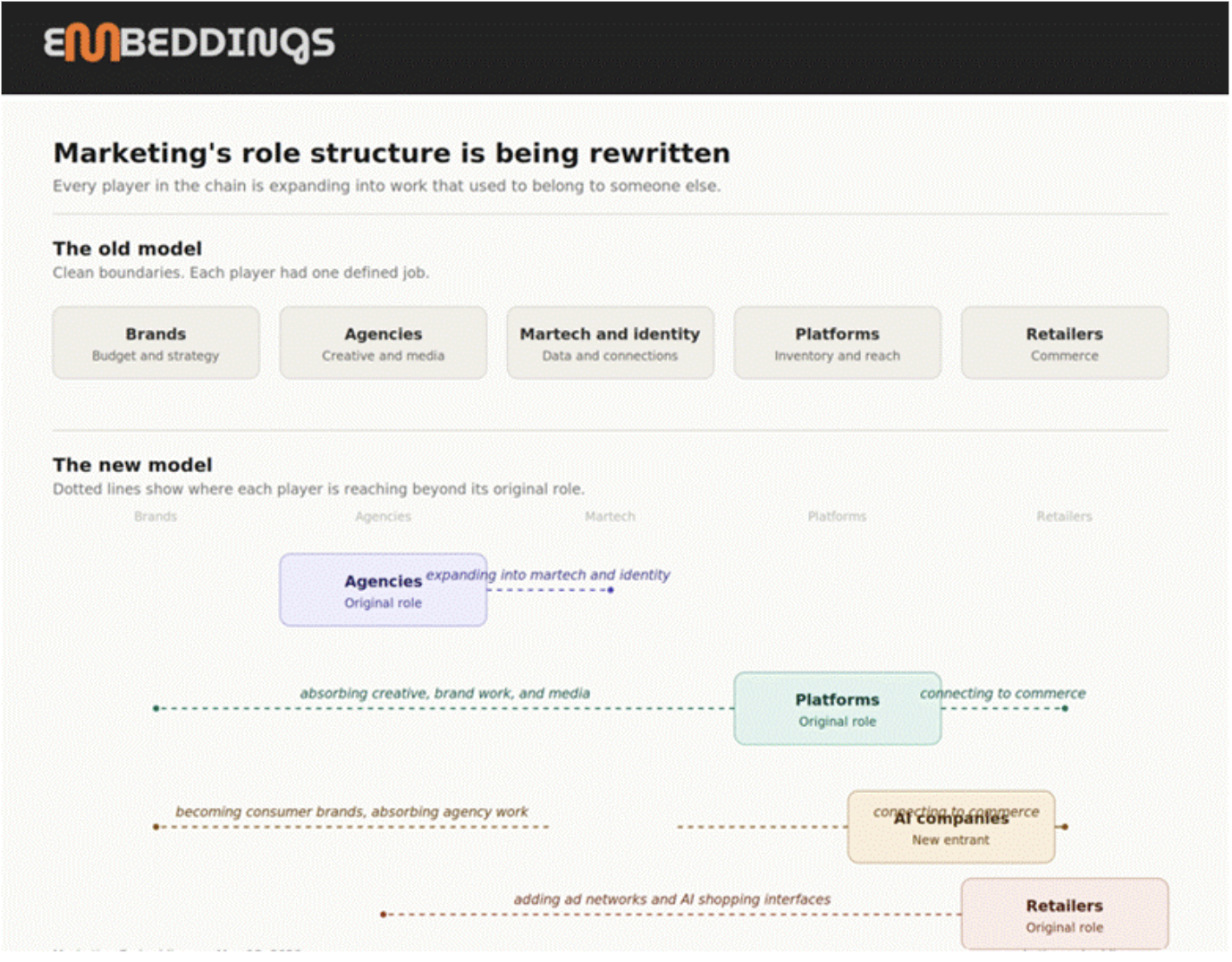
Every player in the chain is expanding into adjacent roles.
The old model held because capabilities were scarce. A platform couldn't make creative at scale. An agency couldn't build a data layer in a year. A retailer couldn't deploy a conversational AI without inventing the underlying model. The boundaries existed because crossing them required capabilities the other players didn't have. That scarcity is gone.
Agencies are becoming infrastructure. Publicis bought Epsilon in 2019 and LiveRamp in 2026. Omnicom acquired Acxiom and is testing AI agents that buy directly from publishers. Both holdcos have concluded that competing on labor is no longer defensible. The asset worth owning is the data and identity substrate underneath advertising.
Platforms are becoming agencies. Meta lets advertisers run Meta campaigns through ChatGPT or Claude via Model Context Protocol. TikTok opened MCP infrastructure so third-party AI agents can build and manage campaigns autonomously. Netflix is selling autonomous ad-buying agents inside its walled garden. These aren't ad features. They're platforms absorbing the work agencies used to do.
Retailers built ad networks over the last few years, putting them in the media business. Now they're adding AI shopping interfaces on top. Amazon's Alexa for Shopping sits in the search bar of the largest commerce platform, on top of Amazon DSP, on top of the largest retail media network, on top of the largest closed-loop commerce dataset. Walmart, Target, and the rest of retail media are building toward the same model.
AI companies are becoming brands and ad networks. ChatGPT and Claude have crossed the threshold from tool to brand. Kantar's BrandZ list, validated through millions of consumer interviews, places ChatGPT at number 15 and Claude at 27. Consumers have brand relationships with AI companies that rank alongside Apple and Coca-Cola. OpenAI is on track for $2.5 billion in ad revenue this year.
Publishers are becoming dual distributors. The Economist is building two versions of its site, one for humans and one for AI agents. Same content, different products. Publishers are no longer in a single distribution business.
Which pieces still matter
Not every piece of the chain holds its value as it integrates. Some are being treated as commoditized. Others are becoming more important.
Creative development is increasingly seen as commoditized. Generative AI has collapsed the cost of producing variations, formats, and campaign assets. The work that occupied entire creative departments is now a feature inside ad platforms.
If that framing wins, commoditized creative eventually stops being worth producing at all. Why pay to make ads that look like everyone else's ads when the agent doing the buying isn't moved by them anyway? Brands that go that route end up relying entirely on marketing to agents: structured data, product feeds, machine-readable signals. The other path is to invest in creative that actually breaks through to humans in an environment saturated with AI output. Good creative becomes more valuable, not less. What disappears is the middle.
Campaign management is being commoditized in the same way. Platforms are absorbing targeting, bidding, optimization, and reporting into automated systems. The MCP infrastructure that Meta, TikTok, and others have opened lets third-party AI agents do the rest. The operator role is shrinking from a craft into a configuration step.
Two pieces are getting more important.
Data and identity access is the substrate that every automated system has to run on. Whoever can resolve identity across walled gardens, retail media, publishers, and AI surfaces holds a position that doesn't get automated away. This is what the holdcos are buying. It's also what platforms with internal identity layers already have.
Access to the consumer is the other piece getting more important, and it's changing shape. Historically, access meant being where consumers paid attention: search, social, retail. Increasingly, it also means being where consumers delegate decisions. As AI agents become buyers on behalf of consumers, access splits into two: reaching the human, and reaching the agent acting for the human. They're related, but they're not the same problem.
The trust question
The harder problem in any integrated stack is trust. When one player controls most of the pieces, the brand has to share data with the same entity that's grading the work. Marketers know how that goes. The promise of integrated performance and closed-loop outcomes is real, and the efficiency case is strong. The long-term strategic bet for marketers, in a world where one or two players run more of the chain on their behalf, is still to be determined.
Vertical integration is the story, and it's a serial one.
TL;DR
The integration is the story, and it's a serial one. The boundaries between marketer, agency, platform, publisher, retailer, and AI company are being rewritten piece by piece. Some pieces lose value as they get integrated. Others become more valuable. The trust question gets answered slowly, deal by deal, quarter by quarter.
We'll keep tracking it.
Other AI news
Salesforce launches Headless 360. Exposes the entire platform as APIs and MCP tools so AI agents can operate it programmatically. Ships 100+ new tools, supports Claude Code and Cursor, deploys agent interfaces across Slack, Teams, and ChatGPT. Backdrop: enterprise software stocks down 28% since September on fears that AI renders traditional SaaS models obsolete.
Cisco cutting 4,000 jobs in AI restructuring as orders surge. Restructuring with simultaneous strong demand is the AI labor playbook now. (Yahoo Finance)
Long Lake acquires Amex's corporate travel platform for $6.3B. Vertical AI consolidation in travel. (Reuters)
Netflix staffs Inkubator, an AI-powered experimental animation studio. Vertical AI consolidation in entertainment. (Animation Magazine)
