
Welcome back, Embedders.
Token prices have fallen 5 to 10 times per year since 2022. A modeled 100-person marketing organization's AI bill has risen 67 times. This week's working paper unpacks why.
Meanwhile, the platforms had a big week. OpenAI shipped three moves: cost-per-action ads, a CMO hire for enterprise software, an expanded Axios Local content deal. Amazon began selling its agentic shopping assistant to competitors. Google added AI shopping insights to Merchant Center. Meta launched paid AI subscriptions. Morgan Stanley doubled its European banking AI job-loss forecast to 400,000 by 2030.
In Policy Corner, AI tax proposals across Washington and Sacramento, and what they mean for agency pricing.
Let's get into it.
— Vas
Big Picture: Cheaper Tokens, Bigger Bills
Working paper preview
Why AI gets cheaper while your AI bill keeps climbing

Frontier AI token prices have fallen 5 to 10 times per year since 2022. Over the same period, a modeled 100-person marketing organization's AI bill has risen 67 times, from roughly $7K in 2023 to a projected $471K in 2026.
The narrative everyone repeats is that AI gets cheaper every year. The data confirms one piece of that. Price per token does fall, sharply. But price is one of five variables that determine total AI cost. The other four are all rising, and together they overwhelm the price fall.
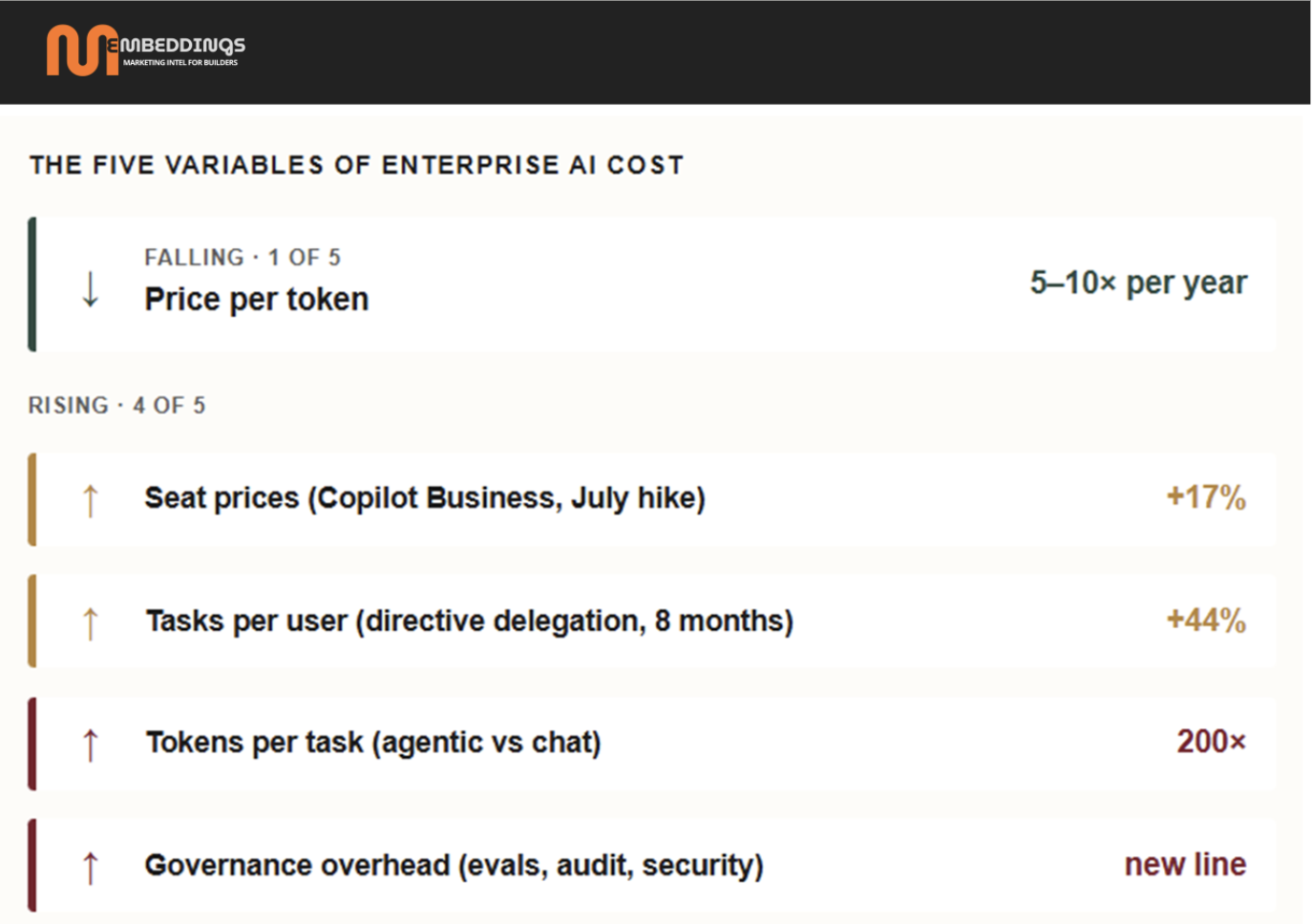
One variable falling. Four variables rising. Sources: Epoch AI / Artificial Analysis (price); Microsoft Copilot pricing (seats); Anthropic Economic Index (tasks per user); Barclays Research and AgencyBench (tokens per task); MIT GenAI Divide and BCG AI at Scale (governance overhead).
Price falls 10 times. Tokens per task multiply by 200. Tasks per user climb. Seats multiply, and the seat price itself rises. Governance arrives as a new budget line entirely. The "prices are falling" headline is the smallest moving variable in the system.
The full working paper walks through the five variables in detail, the three phases enterprises move through (most are stuck in the second), and what to measure before your CFO loses patience.
Policy Corner: Who wants to tax AI, and how
Policy Corner
A cluster of token tax proposals is forming in Washington and Sacramento: Rep. Greg Casar (federal, worker-protection-funded), Tom Steyer (California, state wealth fund), Mark Cuban (under 50¢ per million tokens), Vinod Khosla (sovereign wealth fund). On separate mechanisms, Senator Elizabeth Warren is proposing a per-kilowatt-hour tax on AI data center energy paired with an AI-billionaire wealth tax, and Anthropic CEO Dario Amodei is proposing a 3% tax on AI revenue. None of it is law yet. But agencies are already passing token costs through to clients, and "tokens per campaign" is already moving onto CFO scorecards.
Our AI Policy Lead walks through the proposal cluster, the design debate, and what it means for marketers.
This Week's Signals
OpenAI's platform expansion
OpenAI ships cost-per-action ads in ChatGPT. Advertisers in the pilot now pay only when a user takes a specific action (click, signup, purchase), not for impressions or clicks. CPA is the maturity step from CPM/CPC. Recent hires Dave Dugan (ex-Meta ads), Archana Joshi (ex-Meta), and Sam Mulinder (ex-Snap marketing science) are building the infrastructure. (Digiday)
OpenAI hires Colin Fleming as CMO of its Business unit. Fleming spent two years as CMO at ServiceNow and 13 years at Salesforce as EVP of Global Marketing before that. Pure enterprise SaaS pedigree. The hire signals OpenAI is going at enterprise software as a category, not just selling API access to it. (AdWeek)
Axios + OpenAI expand local news deal. OpenAI is funding Axios Local's expansion from 30 to 43 markets, with an eventual target of 100. Axios gets reporter funding and tokens; OpenAI gets training data and a retrieval feed. Local journalism economics being rewritten through AI patronage. (AdWeek)
AI shopping consolidation
Google adds AI shopping insights to Merchant Center. Retailers now see how their products appear across Search, Gemini, and AI Overviews, with share-of-voice vs similar brands and detection of missing product attributes. Google's framing: "treat product feeds more like SEO content" because shopping is becoming conversational. Defensive move to keep merchants inside Google's surface as AI shopping fragments. (Martech)
OpenAI partners with Skai to bring retail advertisers into ChatGPT. Skai becomes a management layer letting search marketers already buying on Amazon, Walmart, and Google add ChatGPT to their workflow without programmatic specialist work. The strategic frame from an industry source: "someone asking ChatGPT to compare two SUVs has already narrowed it down." Pay-for-performance moments, not CPM. (Digiday)
Amazon sells its Agentic Shopping Assistant to competitors. Kate Spade (Tapestry) is the anchor customer. Amazon packages the tech behind its own shopping assistant and sells it to retailers via Bedrock, AgentCore, and OpenSearch, with ~60-day deployment. The AWS playbook applied to agentic commerce: become the infrastructure for the category, lock everyone into your cloud, set the standards. (Shelly Palmer)
Business models crossing
Meta launches AI subscriptions at $7.99 and $19.99. Part of the Meta One bundle. Rolling out first in Singapore, Guatemala, Bolivia. At 5% conversion the tier could generate ~$4.8B annually, modest against $30B+ in AI infrastructure spend. The diagnostic frame: Meta is moving toward subscriptions because its core business is too dependent on advertising. OpenAI and xAI are moving toward advertising because their core business is too dependent on subscriptions. Each company moves the opposite direction from its core. (TheNextWeb)
Labor compression hits sector data
Morgan Stanley doubles its European banking AI job-loss forecast. From 200,000 in January to 400,000 now, roughly 20% of total European banking employment by 2030. Most exposed: back-office processors, KYC/AML compliance, middle-office risk monitoring. Growing roles: data engineers, AI-platform operators, model-risk specialists. ABN Amro, HSBC, UBS already cutting. The doubling in five months is the signal: AI labor compression is moving from speculative forecast to firming sector projection. (TheNextWeb)
Marketing Embeddings is read by 20,000+ CMOs, CTOs, and media leaders navigating AI's impact on marketing. Forward this to someone who needs to see it.
