
AI saves you 11 hours a week. It takes 6.4 back.
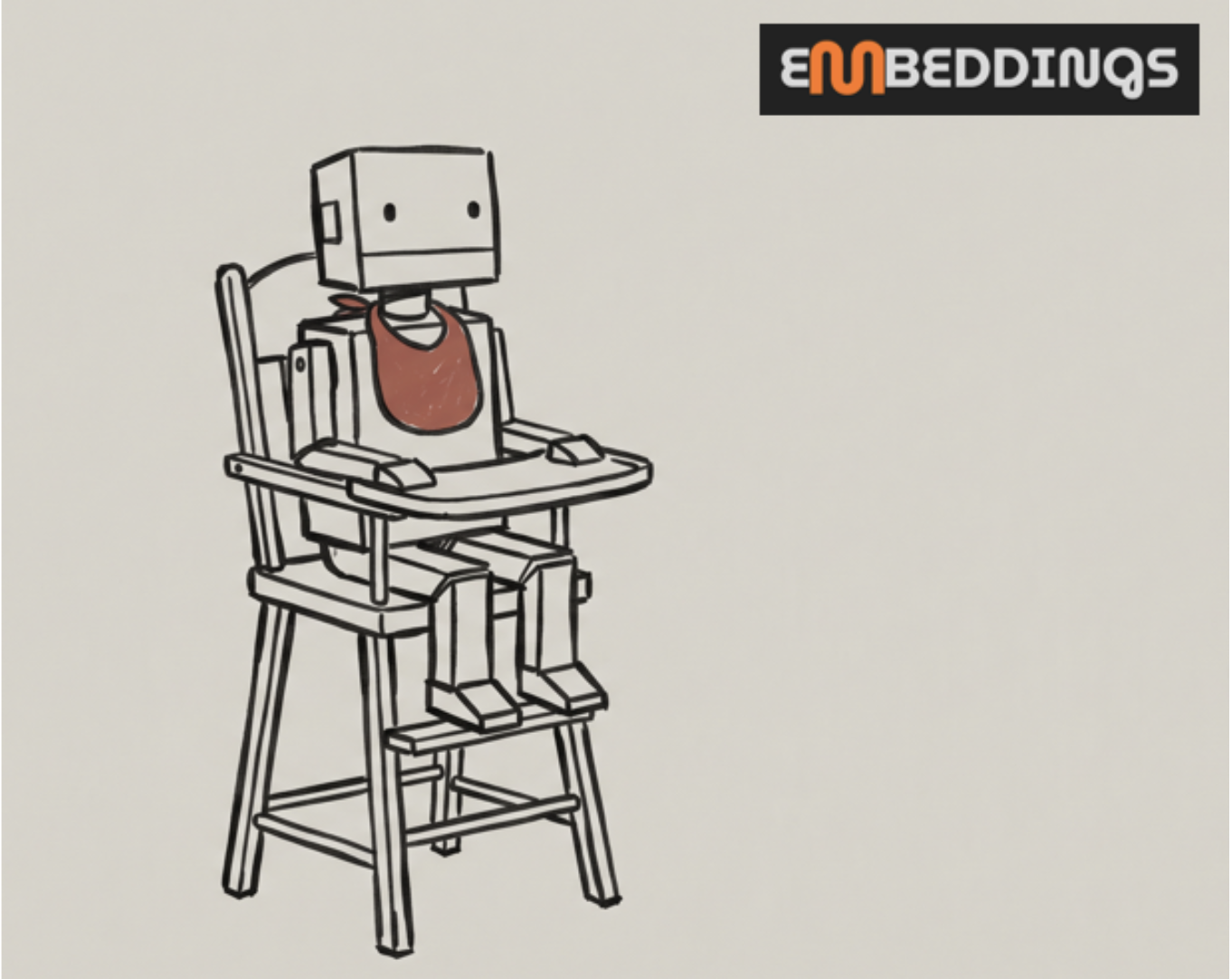
AI is saving workers real time, about 11 hours a week. But a hidden tax called botsitting, the unbudgeted work of feeding, supervising, and cleaning up after the tools, takes most of it back. People now spend more time minding AI than producing with it.
That is the cost most companies have not put on the books. The work that makes AI usable still counts as free, even as it eats the time the tools save. The ones pulling ahead name it, staff it, and keep a human accountable for what ships.
The week showed the bill in other forms. Ford rehired 350 engineers it had cut for AI after quality slipped, the same lesson the hard way. The rest was less about people than hardware: Apple raised prices as AI data centers buy up the world’s memory chips, and Google began rationing Gemini capacity even to Meta.
— Vas
The story: botsitting and botshitting
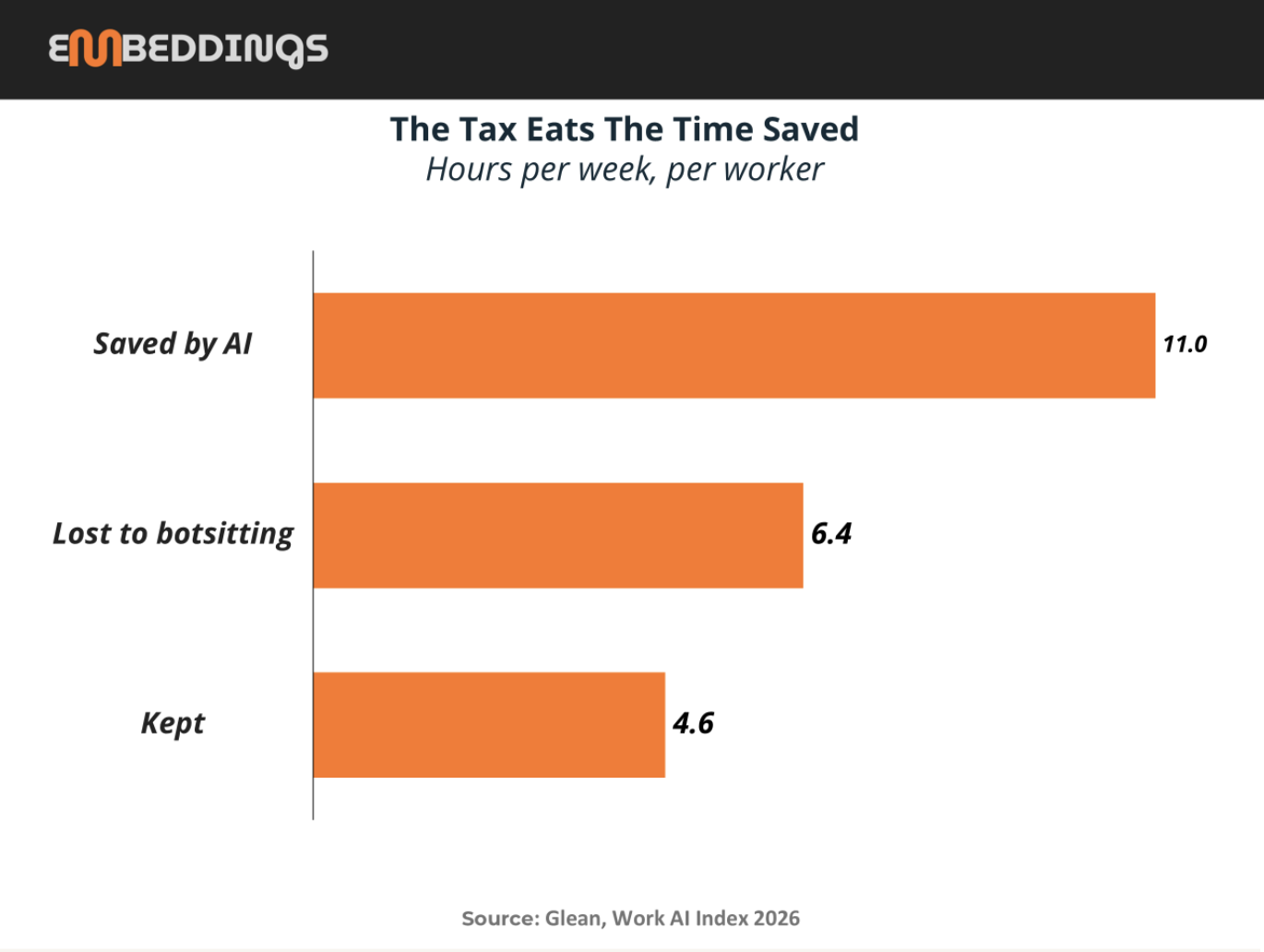
Glean's Work AI Index 2026, a survey of 6,000 full-time workers across the US, UK, and Australia co-authored with researchers at Stanford and Berkeley, measures it precisely. Botsitting is the unbudgeted, untracked work of making AI usable: feeding it the context it lacks, supervising what it returns, debugging its mistakes, and cleaning up the confident-but-wrong answers it leaves behind. It runs 6.4 hours a week, close to a full working day. Of the 11 hours AI saves, botsitting claws back 6.4, leaving 4.6.
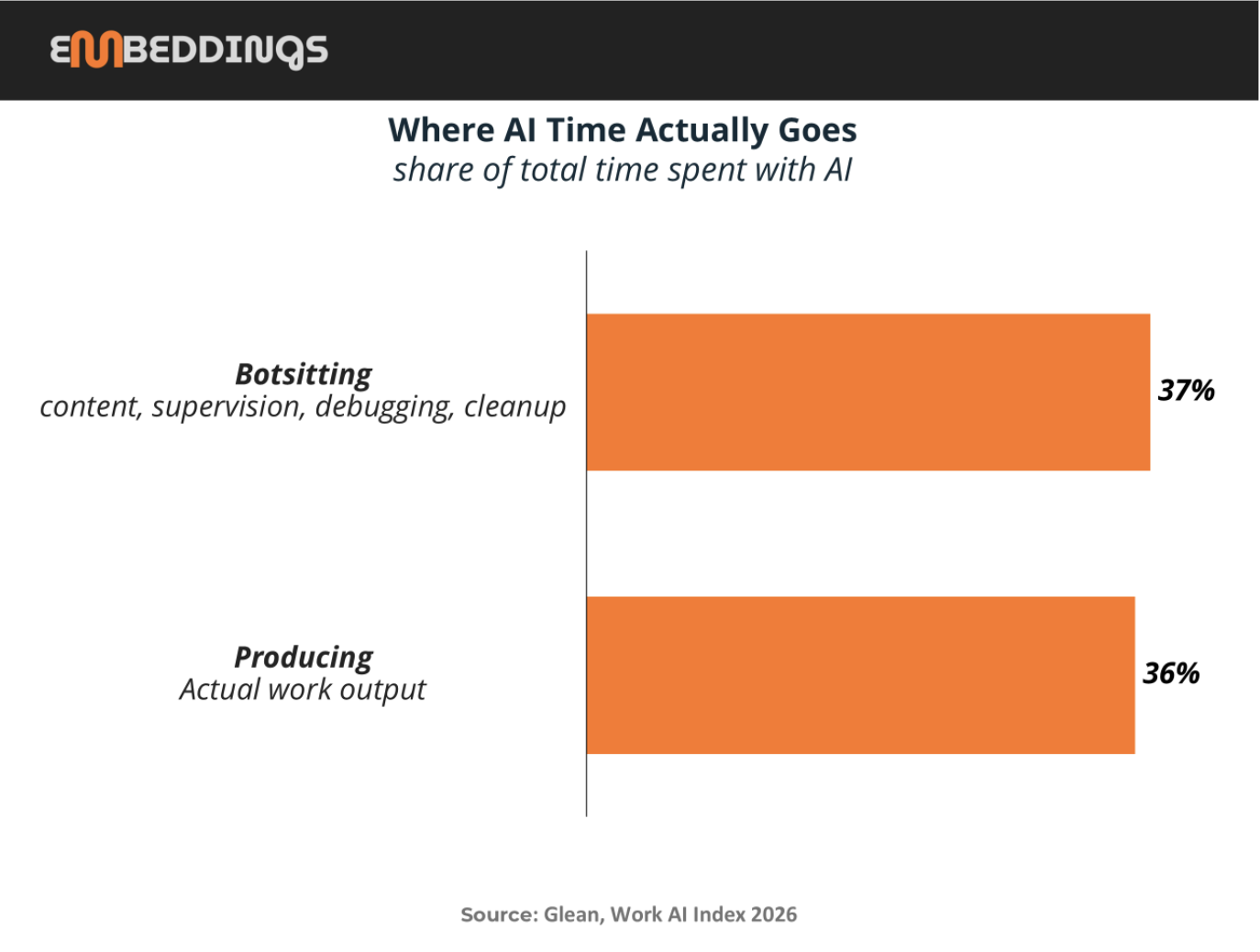
Set against the work itself, the imbalance is starker. Botsitting now eats 37% of all the time people spend with AI, more than the 36% they spend actually producing. The tool meant to do the work needs minding more than the work itself.
Inside that 6.4 hours, feeding context eats the most, roughly 2.3 hours a week, because the model does not know which document is authoritative, what the internal shorthand means, or which workaround the team actually uses. Debugging is the part people find hardest, since fixing a wrong answer means working backward without knowing which missing piece caused it.
Its twin is botshitting: shipping AI work you have not checked, do not fully understand, or could not defend if asked. 69% of users admit to it. 41% have handed over work they could not explain, and when something goes wrong, 40% blame the AI while only 29% take the fault themselves.
The two feed each other. Botsitting wears people down, fatigue invites corner-cutting, unchecked work moves downstream, the cleanup grows, the company buys more AI to cope, and the cycle starts again hotter.
Only 13% of organizations say they are performing significantly better for all the AI they have bought. The gap is not the model. It is everything around it: whether the AI has the context to be right the first time, and whether anyone is accountable for checking it before it ships. The companies pulling ahead are the ones treating that as real work and staffing it, not the ones buying more seats. Last week the pattern was that value goes to whoever steers the tool. This is the bill for letting go of the wheel.
Source: Glean, Work AI Index 2026 (6,000 workers, US / UK / Australia, Dec 2025 to Jan 2026). glean.com/work-ai-institute/work-ai-index
Signals: AI and Marketing
Google's World Cup ads are defending Search itself
Digiday · June 2026
Google is running a year-long World Cup campaign repositioning Search around its Gemini AI, even feeding AI context into Fox's match commentary. The defensiveness is the signal: its search share slipped below 90% for the first time in a decade as users try ChatGPT, Perplexity, and Claude.
digiday.com/marketing/googles-world-cup-brand-counterattack-highlights-shifting-search-behavior
OpenAI says it is now in the advertising business
The Next Web · June 2026
At Cannes, OpenAI confirmed ChatGPT ads are a real business, past $100 million annualized in under two months with fewer than 600 advertisers, and projects $2.5 billion this year. The product sold as an escape from ad-funded media is becoming ad-funded media.
thenextweb.com/news/openai-cannes-chatgpt-advertising-business
Meta courts agencies while automating their job
Digiday · June 2026
Meta rolled out end-to-end AI creative tools, a brand-memory feature, and a WPP integration while calling agencies critical partners. The same tools let advertisers run campaigns without them, and Meta is now projected to pass Google in digital ad revenue this year.
digiday.com/podcasts/with-ai-ad-tools-expanding-meta-courts-agencies-while-reshaping-their-role
Signals: AI and the Big Picture
Ford rehired the engineers AI was meant to replace
The Next Web · June 2026
After experienced staff left before their know-how was captured, Ford's automated quality tools amplified weak inputs instead of catching flaws. It rehired or promoted 350 engineers and added a dedicated quality team.
thenextweb.com/news/ford-rehired-350-engineers-ai-quality-jd-power
AI's appetite is showing up on your Apple bill
AP, via CNN · June 25, 2026
Apple raised prices on 14 products, from $30 to several hundred dollars, blaming a memory-chip shortage as AI data centers buy up the world's DRAM and NAND. The cost of the AI build-out is reaching consumer devices, and Microsoft is raising prices too.
apnews.com/article/apple-mac-ipad-price-increase
AI compute is so scarce Google is rationing Meta
FT, via CNBC and Bloomberg · June 28, 2026
Google capped how much of its Gemini models Meta can buy after Meta's demand outran available capacity, delaying some of Meta's AI projects and pushing it to tell staff to conserve tokens. Compute, not ideas, is the binding constraint, and even the giants are short.
cnbc.com/2026/06/28/google-limits-metas-use-of-its-gemini-ai-models
Marketing Embeddings. Plain prose, named sources, no conclusions we cannot defend.
Sources
Glean, Work AI Index 2026: glean.com/work-ai-institute/work-ai-index
Google World Cup and search shift (Digiday): digiday.com/marketing/googles-world-cup-brand-counterattack-highlights-shifting-search-behavior
OpenAI in the advertising business (The Next Web): thenextweb.com/news/openai-cannes-chatgpt-advertising-business
Meta AI ad tools and agencies (Digiday): digiday.com/podcasts/with-ai-ad-tools-expanding-meta-courts-agencies-while-reshaping-their-role
Ford rehires engineers, JD Power (The Next Web): thenextweb.com/news/ford-rehired-350-engineers-ai-quality-jd-power
Apple raises prices on memory-chip shortage (AP / CNN): apnews.com/article/apple-mac-ipad-price-increase
Google limits Meta's Gemini access, FT (CNBC): cnbc.com/2026/06/28/google-limits-metas-use-of-its-gemini-ai-models
