
$11 a month per employee. That's the median AI budget.
Welcome back, Embedders.
Last week the market panicked. A widely watched token-price index turned down, traders called the top of the AI trade, and for a day the story was that demand had finally cracked. A week on, with the dust settling, that looks like the right chart read the wrong way. The index did fall. But it does not measure what the headlines assumed, and the drop is not the demand crash it looked like. More on that below. Every other number from the week points the other way: the leaders are spending more on AI, not less, optimizing harder, and treating the cost of running it as a job someone now owns. That is this week's lead, and it runs from Ramp's spending data to the looming price war between OpenAI and Anthropic. The hard part of running AI is no longer getting the model to work. It is choosing what to run, on which model, at what cost, and most companies have not yet put anyone in charge of that call.
- Vas
The Cost Signals
The leaders already hired for a job most companies can't name
Last week the market panicked over one chart. Silicon Data's token-expenditure index, a daily measure of what a million tokens actually cost across the market, turned down, and traders read it as proof that AI demand had peaked. But the index is an expenditure-weighted average of what the market pays per million tokens, so when that line falls, it means buyers are getting more efficient, not buying less.
The clearest picture of where enterprise AI is heading comes from the firms furthest down the road, and right now they're sending a signal the market is misreading as a crash. Ramp's June index found the top 1% of companies spending $7,449 per employee per month on AI while the median spends $11.38, a roughly 680x gap, with the top still growing 14% in a single month.
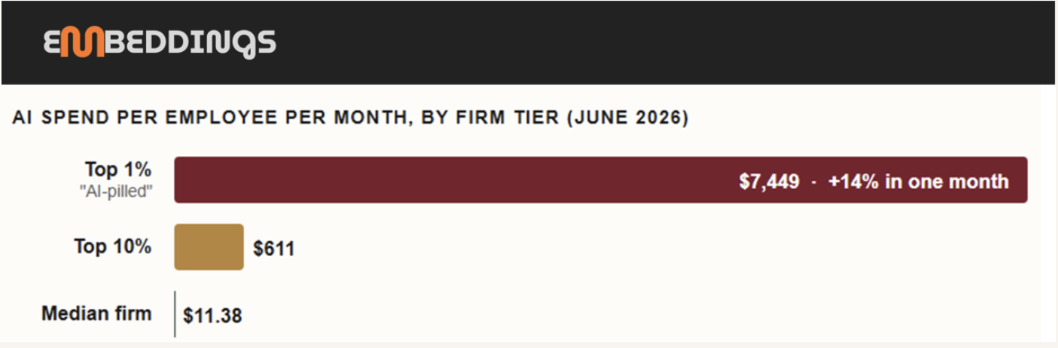
The top 1% spend 680x the median, and the gap is still widening. The median is the thin line you can barely see. Source: Ramp AI Index, June 2026.
Read past the sticker shock and the number isn't one expensive model, it's a portfolio: the leaders route each task to the cheapest tool that clears the bar and save the frontier for work that earns it. That behavior already has a name even if the org chart doesn't, and it's cost engineering.
The vendor count makes the portfolio visible. The top 1% spread their AI work across a median of eight vendors, the top 10% across five, and the median firm across only two. Enterprise software rewards standardizing on one suite; AI rewards the opposite, and the leaders take the trade, shopping each task to whichever model is cheapest for the job.
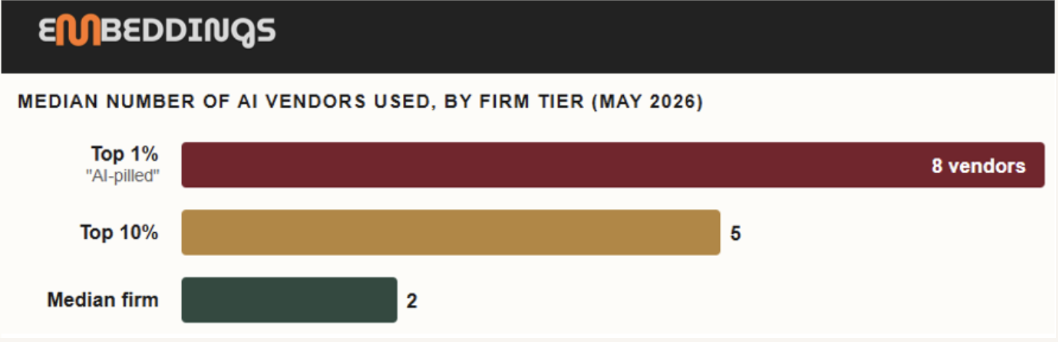
Median number of AI vendors used per firm. Source: Ramp AI Index, May 2026.
The price war is beginning, and it won't shrink the bill
The Wall Street Journal reported this week that OpenAI is weighing drastic price cuts to compete with Anthropic for users, with Sam Altman calling cost "a huge issue" and both companies having filed to go public. A price war sounds like relief for buyers, and the leaders' own data says it won't land that way. When you cut the cost of a token you don't bank the savings, you spend them, because cheaper tokens make agentic workflows viable that weren't before, and those workflows move into production and settle your usage at a permanently higher floor. Then the models keep improving and the next tier lands at a premium, the way Fable shipped at twice the price of Opus and firms climbed to it anyway, so the premium rides on top of a bigger base. Ramp's own economist put it plainly: companies are disciplining cost on the margin, but total spend is rising faster than their willingness to switch to cheaper models, which makes the Cost Engineer's real job allocation, not austerity.
Signals: AI and Marketing
Measurement
ChatGPT learns the oldest trick in advertising: proof. OpenAI partnered with Publicis-owned LiveRamp so ChatGPT advertisers can finally measure whether an ad on the platform drove someone to buy in a store. (Adweek)
Likeness
The creator economy splits into licensed and stolen. Creator Tana Mongeau flagged an AI voice that mimicked hers from Miso Labs, which had boasted it could clone any voice from ten seconds of audio and added "pls don't sue us." For brands the question is no longer whether to use AI likeness but whether the likeness is cleared, because that's the line between a campaign and a lawsuit. (Digiday)
Inventory quality
AI slop found a business model, and it's your media budget. DoubleVerify reports that made-for-advertising sites are using AI-generated "girlfriend ads" to funnel users to pages stuffed with real brands' ads. The networks drew more than 2 million visits a month in Q1 2026. (Digiday)
Signals: AI Big Picture
Payments
Mastercard gave the agents a wallet. Mastercard launched Agent Pay for Machines, a protocol that lets AI agents pay each other across its network in amounts as small as a fraction of a cent, with 30-plus partners including Stripe, Coinbase, and Cloudflare. Its own CFO told Fortune he doesn't expect meaningful revenue next year and called it a five-year bet on machine-to-machine commerce. The people who clear payments for a living are laying rails years ahead of the traffic, which tells you where they think agentic volume is going. (Finextra / Fortune)
Distribution
Google rented the World Cup to ship Gemini. Google made Gemini and Pixel official sponsors of several national teams. A global audience is the cheapest customer acquisition there is, and Google is dressing a Gemini launch as fan service. The part that won't leave when the crowds do is the biometric face-as-ticket entry at the stadiums. (The Next Web)
Policy risk
Palantir's CEO says the government is coming for the labs. Alex Karp told CNBC that full AI nationalization will become the left's mainstream position within two years, claiming he's spent six months warning AI executives the momentum is against them. (The Next Web)
Sources and Links
Cost signals
Ramp AI Index, June 2026 (top 1% $7,449/employee/mo; median $11.38; +14.1% monthly; multi-model portfolios; economist on cost discipline vs total spend): ramp.com
Ramp AI Index data hub (methodology, 70,000+ firms on card and bill-pay data): ramp.com/data/ai-index
Citadel Securities, "Tokenomics" (capability-to-cost framing; price as rationing mechanism; frontier concentrates among a narrower set of firms): citadelsecurities.com
The AI Daily Brief, "The AI Chart Everyone Is Getting Wrong," June 12, 2026 (Silicon Data index measures price-mix from third-party routers, not demand; Goldman 24x by 2030; $11.38 median misread as $1,138; Weinbach ~70% margins): aidailybrief.ai
WSJ, OpenAI considers drastic price cuts (price war with Anthropic; Altman calls cost "a huge issue"; both filed for IPOs): wsj.com
Signals: AI and marketing
Adweek, OpenAI partners with LiveRamp (ChatGPT ads + LiveRamp CAPI Hub for in-store conversion measurement; LiveRamp is Publicis-owned): adweek.com
Digiday, AI clones split the creator economy (licensed twins vs unauthorized clones; Tana Mongeau / Miso Labs): digiday.com
Digiday, AI "girlfriend ads" fueling MFA sites (DoubleVerify report; 2M+ visits/mo in Q1 2026): digiday.com
Signals: AI big picture
Mastercard, Agent Pay for Machines (machine-to-machine payments; sub-cent microtransactions; 30+ partners incl. Stripe, Coinbase, Cloudflare; CFO Jorn Lambert framing it as a five-year bet): Finextra · Fortune · Investor release
The Next Web, World Cup biometrics + Google Gemini (Gemini/Pixel sponsorships; fan features across Search/Maps/Waze/Gemini; biometric face-as-ticket; ACLU/Amnesty travel advisory): thenextweb.com
The Next Web, Palantir's Karp on AI nationalization (full nationalization becomes the left's mainstream position within two years; Trump/Sanders 50% framing): thenextweb.com
Marketing Embeddings is read by 20,000+ CMOs, CTOs, and media leaders navigating AI's impact on marketing. Sequel to "The Rise of the Cost Engineer" and the working paper "The Economics of Enterprise AI." Forward this to someone who needs to see it.
